Long before Hollywood titan Steven Spielberg announced he would bring the stars back down to Earth with his new box office contender Disclosure Day, humans have pondered the conundrum of whether we are alone in the universe or not.
In the 90s, Mulder and Scully’s first case reignited popular culture’s fascination with the mystery-shrouded legacy of what happened at Roswell in 1947 and the Nevada desert’s secret compound, Area 51, thereafter. But for an entire generation before that (and, no doubt, their kids since), the alien probe was inserted thanks to Spielberg.
The Jaws director leapt from the inner space of the ocean’s fury to the outer realms beyond our galaxy with 1977’s Close Encounters of the Third Kind, solidifying our ongoing belief in the possibility of life from other worlds, and their uncanny interest in our own.
Spielberg solidified his intergalactic vision with the gung-ho adventure of E.T. the Extra-Terrestrial five years later.
The film’s title was borrowed from the work of astrologer and ufologist J Allen Hynek, who coined a spectrum of encounters, with the third kind referring to reports of a direct meeting between humans and extraterrestrials.
Hynek spoke with authority, having been recruited by the US Air Force as a scientific advisor on the contentious issue, investigating evidence from decades of so-called close encounters.
Grainy pictures and video clips revealing so-called UFO wreckage and their pilots have captivated folks all over this world, as have flashes of top-secret files, with the current inhabitant of the White House recently unsealing reams of the stuff, presumably to distract from his clusterfuck of rolling crises.
But are they really out there?
Disclosure Day – quick links
Spielberg: working-class reality
Spielberg certainly thinks so. He was obsessed by the tantalising promise of proof, and the fantastical fictions spun from it – films like Robert Wise’s iconic 1951 classic The Day the Earth Stood Still, and Byron Haskin’s seminal take on the HG Wells story, The War of the Worlds, that Spielberg would grow up to remake with Tom Cruise in 2005.
It’s not surprising, then, that, flush with cash from Jaws’ industry-redefining success, Spielberg’s rising star would ignite with Close Encounters.
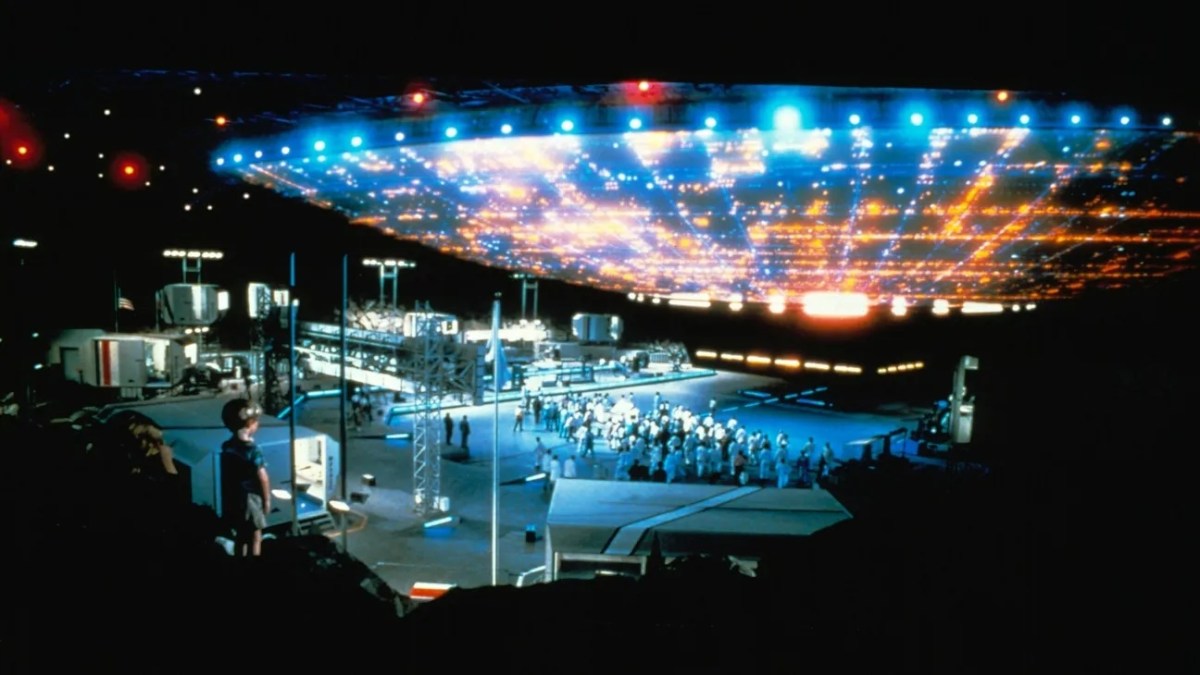
The magnificent film’s enduring place in cinematic history is surely down to Spielberg’s canny reckoning that third kind encounters work best as viewed not through the clandestine machinery of government, but through everyday folks caught up in the starry-eyed spectacle.
Folks like Richard Dreyfuss’ blue-collar sparky, Roy Neary, his wife Ronnie (Teri Garr), and their three kids, Brad (Shawn Bishop), Silvia (Adrienne Campbell) and Toby (Justin Dreyfuss, Richard’s real-life nephew). And Melinda Dillon’s single mum, Jillian, and her three-year-old, Barry (Cary Guffey).
It was through their eyes, filled with fear and loving, that we climbed Wyoming’s Devils Tower together, overcoming any internal resistance to alien existence to the tune of legendary composer John Williams doo-doo-doo-doo-doos.
Spielberg: childlike wonder
If Close Encounters hewed closer to the incredulous experience of adults, then E.T., which closed the 1982 Cannes Film Festival, was ablaze with the wide-eyed wonder of kids and their willingness to believe in what their parents insist cannot be real.
And yet it soars precisely because it is grounded in truth. Spielberg’s closest dalliance with his family story up to that point, it breathes life into the imaginary friend he conjured when his parents were divorcing.
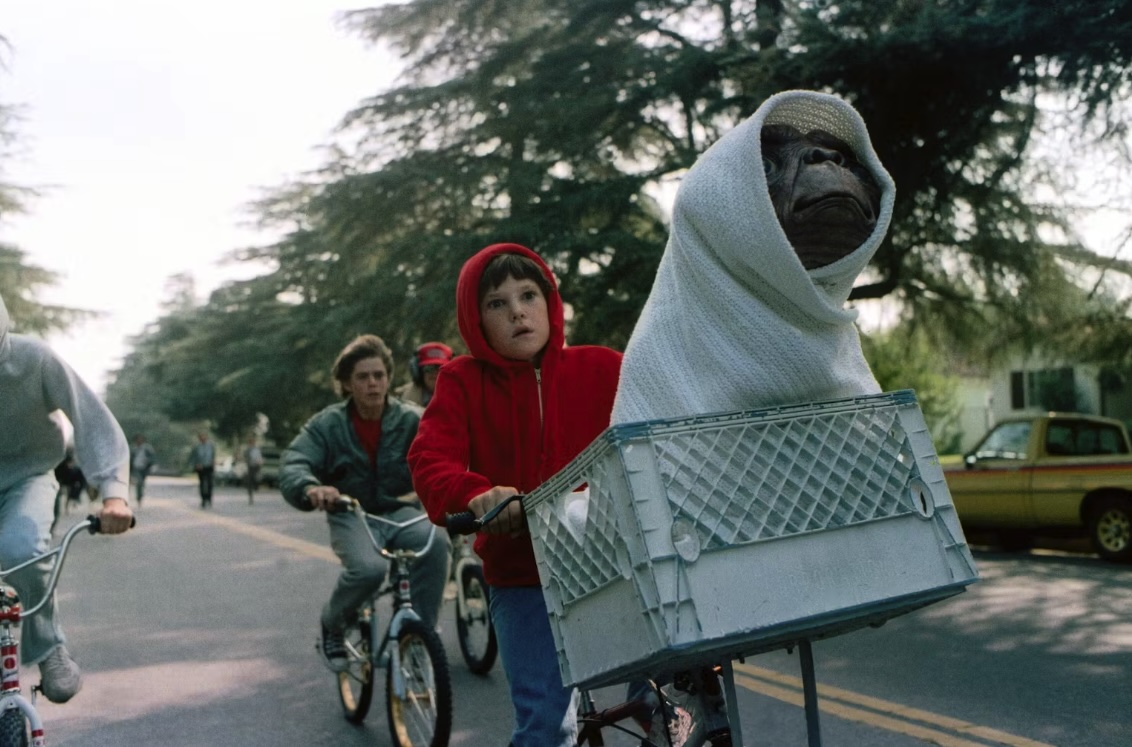
Henry Thomas, as the ten-year-old Elliott, is Spielberg’s stand-in. He befriends the lonely alien of the title, accidentally left behind by his people during an exploratory plant harvesting mission, eventually introducing the finger-glowing, long-necked creature to his little sister, Gertie (Drew Barrymore), roughhousing teenage brother, Michael (Robert MacNaughton) and Michael’s mates.
Again, a single mum is a reluctant hero, in the shape of Dee Wallace’s Mary.
Together, they band by ET’s side, determined to reconnect him to his people before insidious government agents can cut him up in scientific research. This peril, and the determination of tiny folks to fight back, Ewok-style, captivated similarly teeny me.
Disclosure Day: down to earth
I was excited to see how a septuagenarian Spielberg would bring new life to the aliens who
walk amongst us. Sadly, Disclosure Day, written by Jurassic Park scribe David Koepp, is a pale
shadow of these twin planets of my childhood.
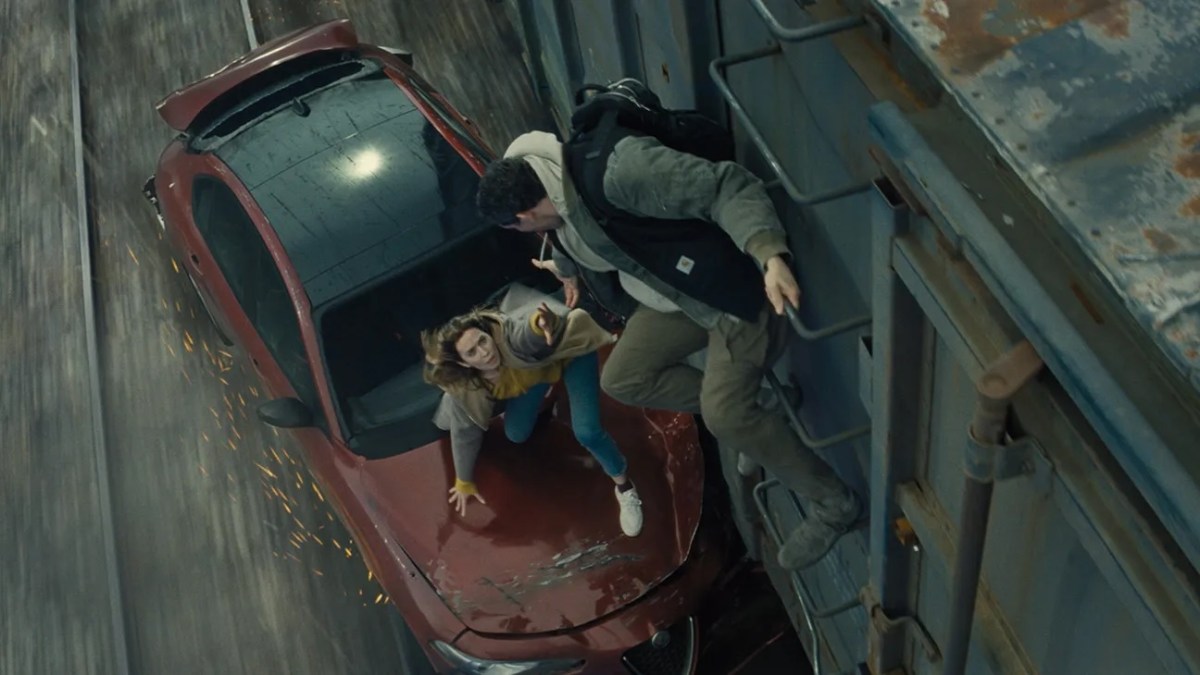
While not directly linked to either ET or Close Encounters, the bones are similar. The History of Sound star Josh O’Connor is a cyber-security expert, Daniel, who goes on the run from his similarly shady pseudo-governmental agency, run by a nefariously bearded Colin Firth’s bad boss, Noah.
Noah is determined that humanity can’t handle the truth of alien life. Daniel and his fellow defector, Colman Domingo’s Hugo, are equally adamant that all eight billion of us deserve to know.
So Daniel goes on the run with a trove of video evidence and an alien artefact of incredible power that allows the bearer to psychically connect with others. His girlfriend, Bad Sisters star Eve Hewson’s Jane, is an ex-novitiate experiencing a crisis of faith.
While Jane may be unsure of her relationship to the divine, she’s easily brought into the alien existence fold by Daniel’s secret stache, though worries it will cause a mass crisis of faith.
Apologies to those who believe on that front, but Spielberg’s religious bent is far too heavy-handed here, right down to bleeding stigmata and a crucifix warding off evil.
It’s not the only clunky element of Disclosure Day, which is bogged down in lumpen exposition, stodgy dialogue that no human not addicted to ChatGPT would ever speak and a near-total lack of believable action, with the ghost of conceivable reality given over to weightless CGI.
It is by far his ugliest film, with the lifeless flatness and grubby lighting of the cheaper end of straight-to-Netflix movies (though this one cost a fortune).
Disclosure Day: Blunt reality
Not even The Devil Wears Prada antagonist Emily Blunt can save it, as the most ground-level of our characters, Kansas City weather reporter Margaret.
She, like Daniel, shows signs of being able to communicate with the great unknown that lights up our skies. If only her abundant on-screen luminosity could brighten this oddly small-scale story that nevertheless lacks the human heartbeat of ET or Close Encounters.
It’s not a total bust. There are moments of Spielbergian magic in the muddle, including a handful of fun camerawork flourishes from cinematographer Janusz Kaminski, but it’s not enough to achieve liftoff velocity.
Even a score from a returning Williams feels half-hearted. No-one will be humming it in 40 years’ time. And that I would never have believed.