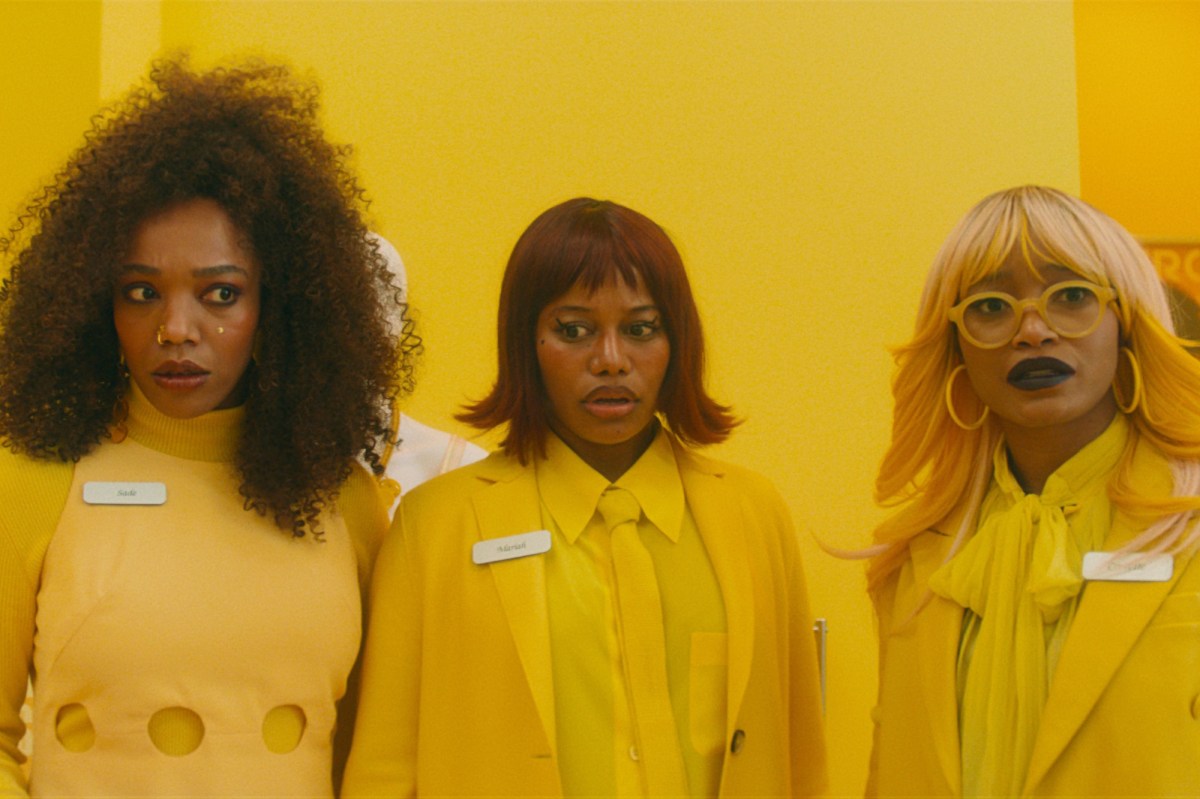
I Love Boosters, the latest from the astonishingly creative filmmaker Boots Riley, is one of the most wildly original films you’ll see all year, bringing anti-capitalist punch wrapped up in the velvet glove of Michel Gondry-like practical magic.
It’s been a lot wait, with the film debuting at SXSW in March. But it’s fitting that the hilariously exaggerated crime caper – starring Keke Palmer, Naomi Ackie and Taylour Paige as members of the shoplifting Velvet Gang – finally arrives in Australia as the globe is overturned by people-power uprisings.
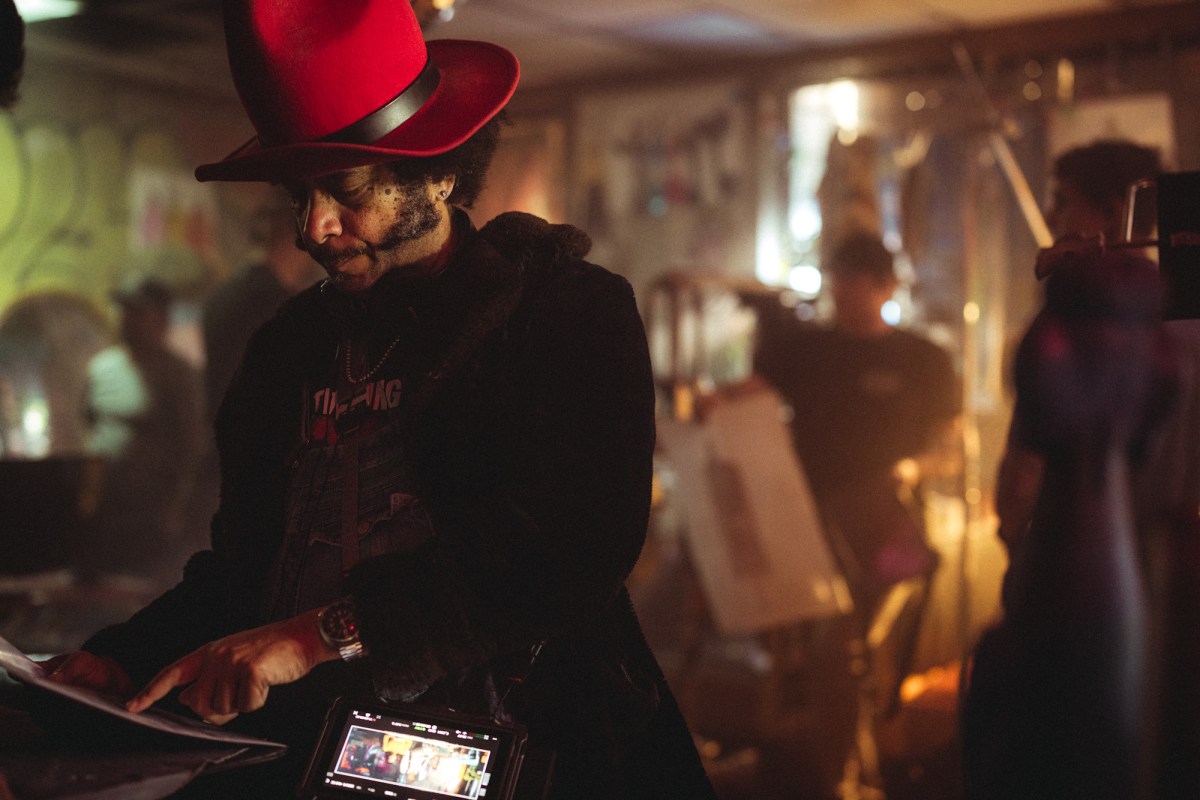
‘What’s interesting is that on 17 October, when I was showing the film in Paris, there were police literally shooting smoke bombs,’ says Riley, wearing his trademark big and bright hat. ‘People came from those protests to see the movie. We had our Brazilian premiere the day before elections, and I was out in the street with folks.’
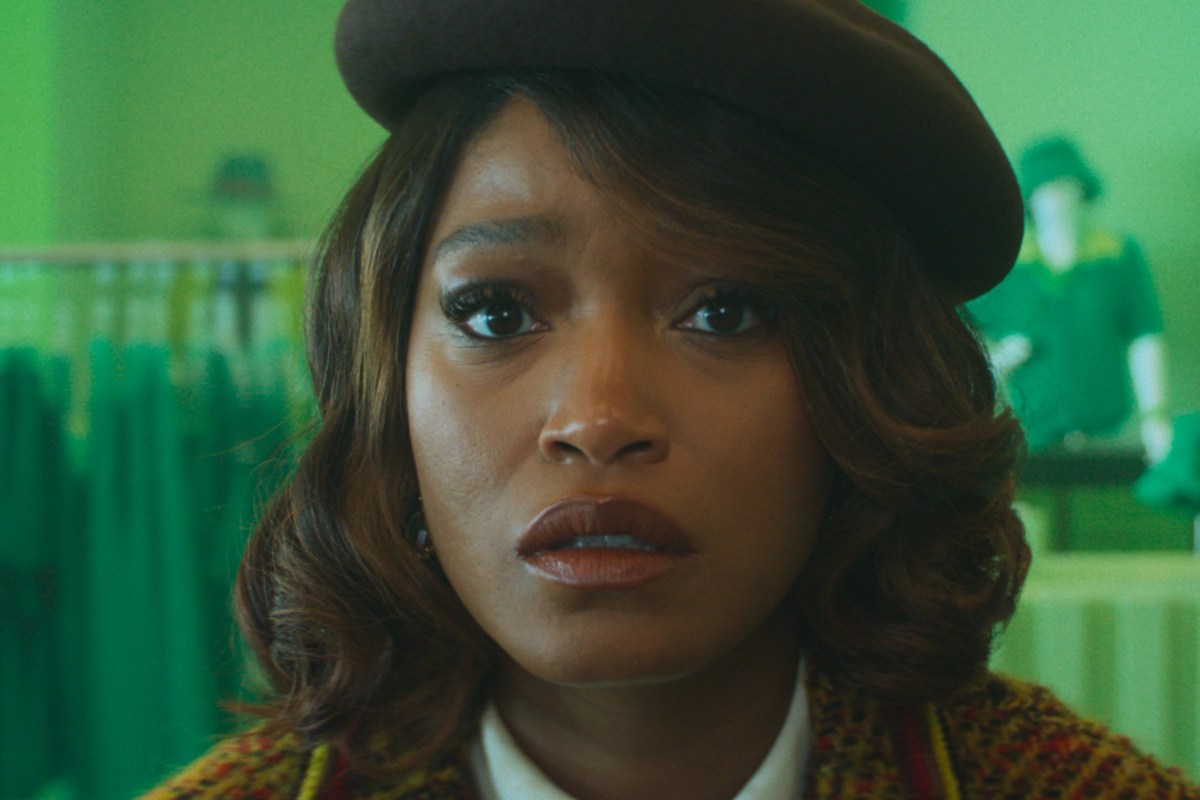
From Brazil to France, India to the ‘Blue Wave’ midterms in the US, there’s an energy in the air that matches that of I Love Boosters. Palmer’s Velvet Gang leader, Corvette, squats in an abandoned fried chicken shop, leading Sade and Mariah on recce missions to scope out Metro Designer stores.
Much to the chagrin of Will Poulter’s stuck-up store manager Grayson, the girls strip-mine the obscenely-priced, Kawakubo-adjacent gear from the atelier of fashion queen Christie Smith (The Substance star Demi Moore), whose severe hair makes her look a bit like Andy Warhol and Cruella de Vil time-sharing the same body.
The Velvet Gang aren’t doing this for their own benefit, or at least not entirely. By boosting the fits, selling them on at a fraction of the price, they’re democratising fashion, making it more available to those who cannot afford it. This, while kneecapping the very business that holds them at arm’s length.
That manifesto is deepened and broadened when Corvette and co are further influenced by unionist Metro Designer sales assistant Violeta (3 Body Problem‘s Eiza González) and Chinese factory worker Jianhu (Hacks’ Poppy Liu).
‘It’s a strategy to win, right?’ Riley says of this have-a-go revolution that burns like a street protest against the cost-of-living crisis and its diminishing of dreams and potential.
‘Boosters talks about actual class struggle and organising on the job, creating a mass militant radical labour movement, thinking about things not just in terms of spectacle [and] showing that people are out on the street, but actually building a power base.’
Boots Riley on I Love Boosters – quick links
Wonka flips
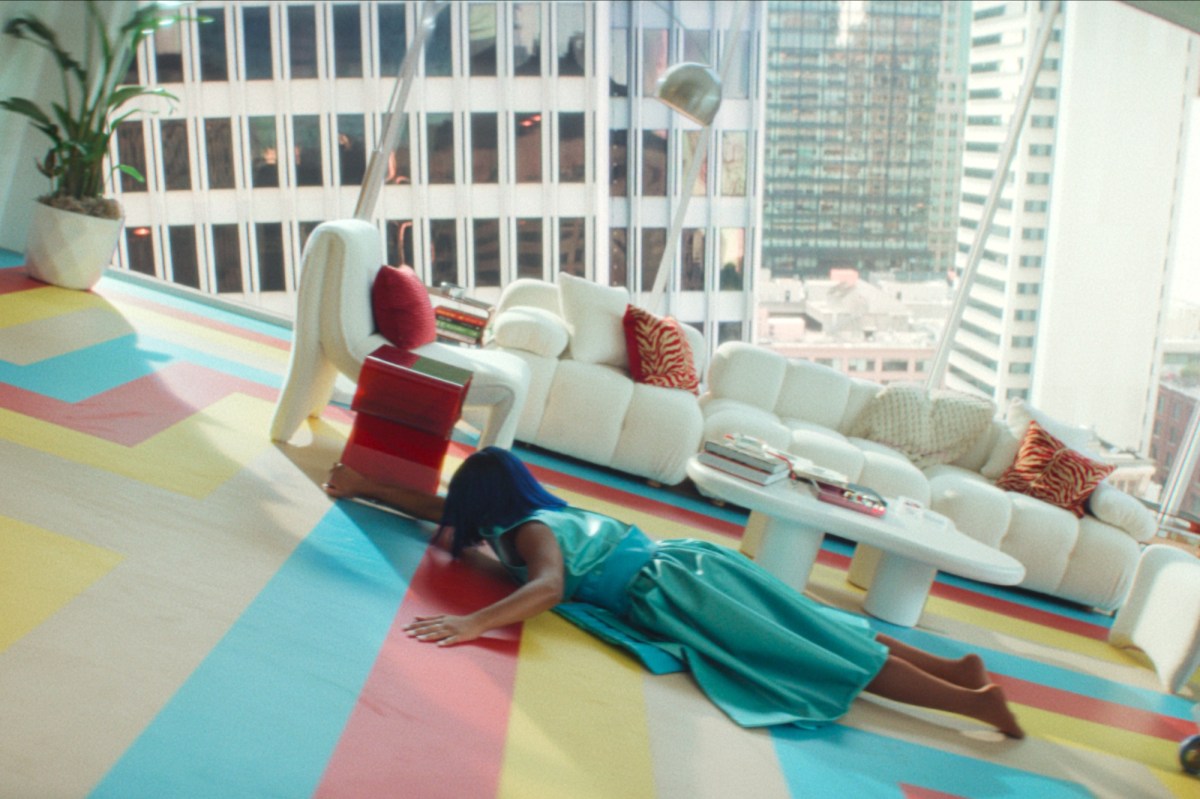
If this all sounds very serious, then trust us, I Love Boosters is a hoot. Christie’s designer HQ is tilted on such a precarious angle that it makes the Tower of Pisa seem lazy, for no discernible reason other than it brings Monty Python-esque wondrous mania to the mix.
As do muscle-exposed stop-motion henchmen who shed their skin suits, plus giant balls of garbage, and a machine that adjusts space, time and situations, driven by a chaos engine that appears to have crash-landed from Douglas Adams’ The Hitchhiker’s Guide to the Galaxy.
Oh, and then there’s dreamy LaKeith Stanfield, who led Riley’s similarly themed debut feature Sorry To Bother You, who appears as a Faustian demon who gives the best cunnilingus but will steal your soul in return. Argentinian cinematographer Natasha Braier, who imports her bold colour palette from The Neon Demon, worked with Riley and Panavision genius Dan Sasaki to get Stanfield’s siren-like stare just right. ‘Dan invented a lens we could use for that,’ Riley says.
It all adds up to a real good time. Perhaps too much, when it came to getting that shot. ‘They were all laughing so much together that I’d be like, “OK, we gotta start shooting in a second.” There was a constant party going on for like 45 days.’

Scoring comeback queen Moore as his Cruella de Villain, Christie, was a coup, helping Riley fuel I Love Boosters’ creative engine. ‘When Demi came on board, she made things happen,’ the director says. ‘Creatively, she was so down to do stuff.’
Again, Riley had to rein things in. ‘Demi was basing her performance off a designer she knows, with some artists I follow, and then a little bit of Willy Wonka,’ Riley says of her heightened turn.
‘We filmed the fashion show on her first day and I joked, “Wouldn’t it be crazy if you did a somersault, like Willy Wonka does?” And she was like, “I’m gonna do it.” I had to talk her out of it, because we couldn’t afford her breaking a leg.’ Literally.
Watch the trailer
Wood-licker
A visual feast, I Love Boosters relishes wearing its practical effects on its multicoloured sleeves, including toy cars racing model streetscapes whipped up by miniatures wizard Christopher Warren at Blind Beagle, with the film’s end credits also shouting out proponents such as Ryan Coogler, Jordan Peele and Guillermo del Toro.
‘I like textures, things you can feel,’ Riley says of creating as much as possible in-camera, rather than ‘fixing’ it in post-production with CGI. ‘It gives everything more depth. I want art with people’s passion.’
Practical feels better. ‘You know, CGI isn’t really able to replicate light in the same way,’ Riley insists, turning to point at a wood-panelled wall over his shoulder. ‘Now, I haven’t put my mouth on that, and neither have you, but maybe when we were two, we went around putting everything in our mouths.’
No, this isn’t about to take a turn for Alexander Skarsgård’s wotsit in Wicker. ‘Because of that, we can imagine what it tastes like, what it feels like. And that is missing, even with the likes of Pixar. We need these real textures for it to feel magical and wondrous.’
That magic includes working with stop-motion animators Ri Crawford and David Lauer at Mystery Meat Media to get under the skin of Don Cheadle’s pyramid-scheme-pushing life coach, Dr Jack, Ray Harryhausen-style.
‘I wanted that to feel macabre, so I called Ri and David, who worked with me on Sorry to Bother You and I’m a Virgo,’ Riley says. ‘There’s something about stop-motion. I think your brain sees that it’s something in real space. Whereas with CGI, it’s all smoothed over and it wouldn’t be amazing.’
Sounding out the vision
A rapper who fronts hip-hop outfit The Coup and teams up with Rage Against the Machine’s Tom Morello on supergroup Street Sweeper Social Club, Riley is equally enamoured with how a film sounds, with supervising sound editor Andre Fenley going large and Looney Tunes wacky.
‘Listen, the sound is how I trick you into liking the movie, right?’ Riley smiles. That includes working with Oakland-based music project of Merrill Garbus and Nate Brenner (aka Tune-Yards) on the effervescently popping score.
‘They are musical geniuses,’ Riley says. ‘They’re also a couple, and they’re always talking about their work, so I got a lot out of them. They’re used to making songs so catchy that they pull you in. You’re gonna go home humming.’
It’s a basic building block of cinema all too often overlooked by the biggest budget movies. ‘It’s like Marvel movies, right? You can sing the old Spider-Man theme, but if you try to remember the score of any of their current movies, you’d be stuck.’
Thrifty fits
You won’t have trouble trying to recall I Love Boosters, which, on every level, has been lovingly designed to stick like a doomed fly to honey. Especially Everything Everywhere All at Once costume designer Shirley Kurata’s eye-popping looks.
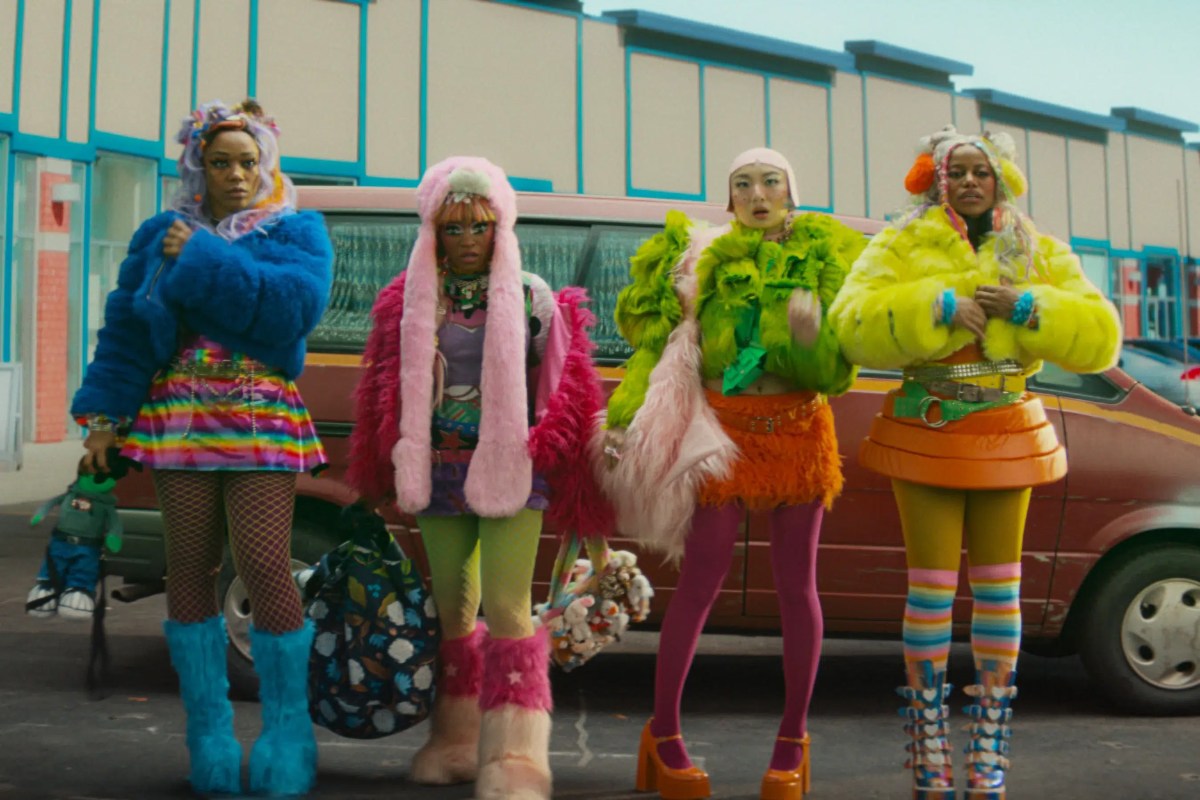
Riley loved working with her. And while Christie is the biggest bad, other than the people-chewing death spiral that is late-stage capitalism itself, the director isn’t actually anti-fashion, as one glance at his out-there ensembles would prove.
‘Fashion, for a lot of people, is the only way, after working all day, that they can figure out how to express themselves and be creative in that way,’ Riley says.
It’s just that he’s thriftier. ‘I don’t really know designers,’ he says. ‘I’m not that kind of guy. I get my stuff from vintage stores normally, though now that I’m known, people do send me stuff for free, which is good, but it also feels like cheating.’
What’s not cheating is I Love Booster’s authentically bonkers world, and it would be criminal not to catch it in cinema.
‘It’s the absurdity, right?’ Riley grins. ‘It’s about heightening the contradictions in life to the point that you can feel it, and sometimes in feeling that, the heightening ends up being explosive laughter.’