Of all the rabbit holes I’ve fallen down while writing about film, compiling a history of cinematic cumshots – a cumpilation, if you will – is one of the weirdest. But here we are, all thanks to the orgasmic power of Melbourne International Film Festival wonder, Phillip Philadelphia.
The deliriously good fourth feature from experimentally wild filmmaker and boundary-breaker Adam C Briggs, who co-directed the feral 2024 film A Grand Mockery with Sam Dixon, begins with the cut-and-thrust of American wannabe star Antony Bogarde (Oliver Cameron).
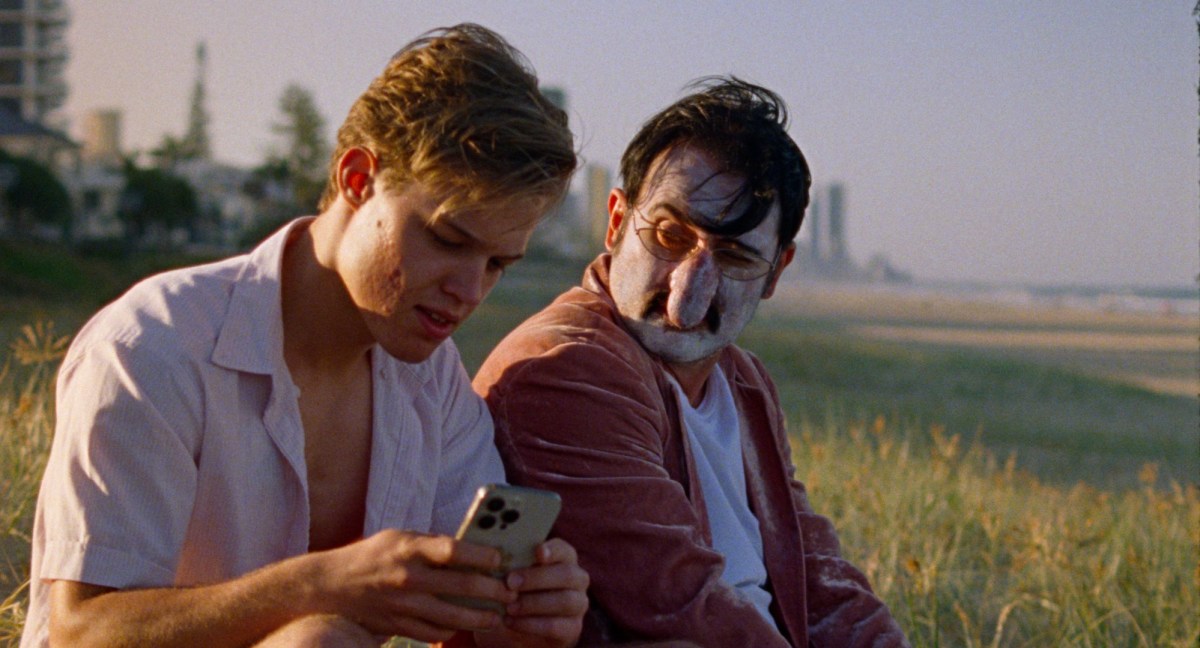
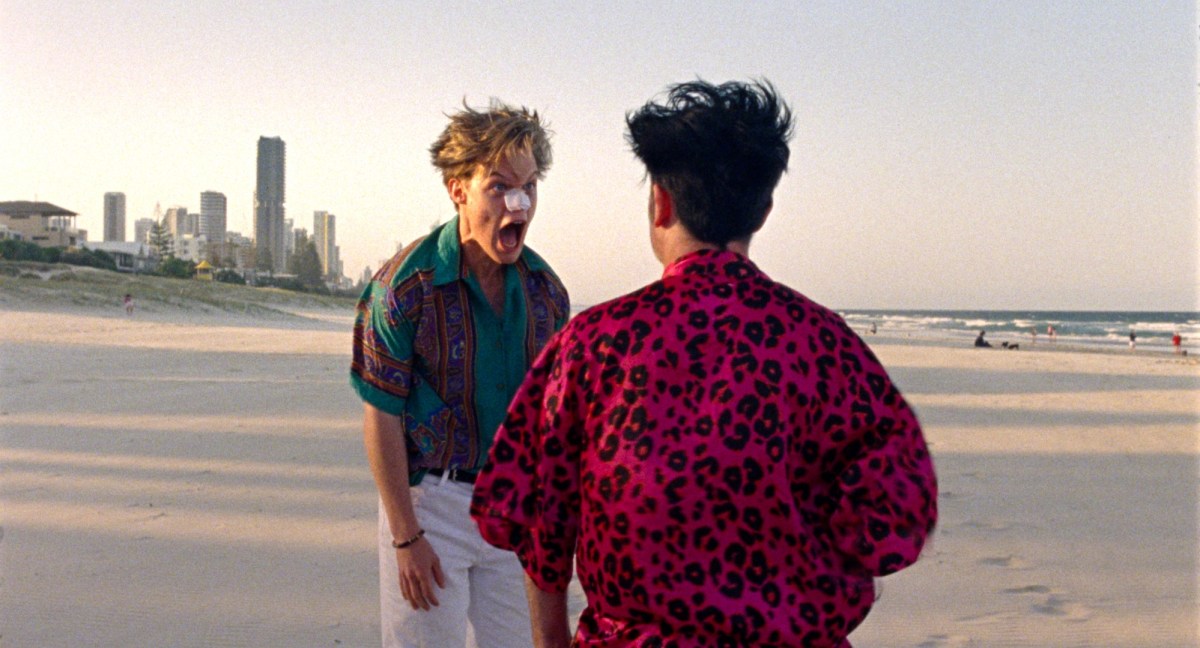
The brilliantly Hollyporn-named demon twink and aspiring actor – a terrifying combination – looks like a young Matt Damon and he knows it. He’ll happily sleep his way to any top. A social climber with a misguided sense of trust, he’s hitched his fate to the washed-up, semi-rotten carcass of the titular British filmmaker Phillip Philadelphia (Oscar campaign for Geoffrey Vagg when?) but is beginning to suspect he’s been hoodwinked for sexual favours.
ScreenHub: All the highlights of this year’s Melbourne International Film Festival
Decked in a crushed pink velvet suit that’s seen better days and with a strange zinc-like smear of corpse-adjacent yellowy white spreading across his face, the Englishman may or may not have been a big deal once upon a time. These days, Phillip is wasting away in a shady Gold Coast motel that draws a seedy crowd.
This doesn’t deter Antony from riding Phillip like he’s the last rodeo, resulting in one of cinema’s most hilariously on point money shots, unleashing an abundance of ropey milkiness on the director’s comically bulbous snoz.
Cue the audience erupting in synchronised hysteria during this sweaty, sticky fever dream of a film’s ecstatic world premiere at MIFF, and me embarking on very NSFW research…
Phillip Philadelphia review – quick links
A smutty intermission
Many moons before OnlyFans reinvented the wheel, the first filmed-for-consumption cumshots popped up in an illegal proliferation of underground ‘stag’ movies. Sex sells, after all, and the hunger’s real, as old as humanity (and the filmed form) itself.
As cinema was dawning, Brazilian pornographers, as early as 1893, were among the first customers for Thomas Edison’s Kinetoscope camera, with French and Argentinian filmmakers not far behind.
The burgeoning trade in increasingly risqué smut wasn’t just a man’s game, with many of cinema’s women pioneers also buying in. British director Esme Collins’ 1896 movie A Woman Undressing is one of the form’s earliest titillations.
But as the movies solidified themselves within popular culture, explicit sex was purposefully held at arm’s length. Teasing, or the power of suggestion, pulled the spotlight, especially as the morality police of the Hays Code asserted its chokehold on Hollywood.
As pornography split off, wrapped in brown paper, the cumshot’s only close-up was, for a long time, in the XXX realm of peepshow cinemas, brothels and the like, before heading home on VHS and other home media, eventually leading us to the tyranny of the internet.
Following 1967’s Summer of Love, the lines between cinematic ‘art’ and porn began to blur, to varying degrees of explicitness. Andy Warhol’s 1969 Blue Film was pretty coy, Gerard Damiano’s Linda Lovelace-led Deep Throat (1972) less so. They both broke ranks, spilling into the mainstream, as did Wakefield Poole’s seminal (sorry) queer offering, Boys in the Sand (1971), with even Liza Minelli showing up to the latter’s New York premiere.
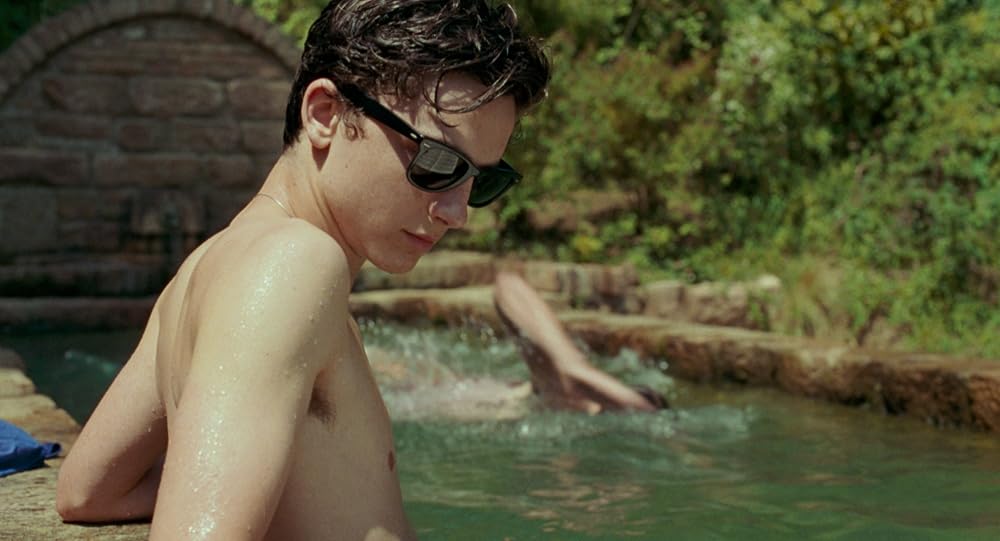
And yet jizz shots remain few and far between in non-pornographic movies. You’re far more likely to witness the aftermath, like Cameron Diaz’s unwitting hair gel in There’s Something About Mary (1998), the peach treat of Call Me By Your Name (2017) or the admittedly saucier splashdown in Andrew Haigh’s Weekend (2011).
There are notable exceptions. Vincent Gallo distracts himself from cannibalistic urges with a sink jerk in Claire Denis’ deliciously wicked Trouble Every Day (2011). John Cameron Mitchell’s Shortbus (2006) wastes no time, opening on Paul Dawson’s oral self-service to completion. Alain Guiraudie’s Strangers by the Lake (2013) is basically one big beat-off.
Masturbation mostly doesn’t live up to the title of Todd Solondz’ disturbing Happiness (1998). It’s mired in a murky murder mystery in Nagisa Ōshima’s In the Realm of the Senses (1976). James Ransone’s autoerotic asphyxiation moment in Larry Clark’s Ken Park (2002) caused quite the scene. Even I baulked at the internal 3D money shot in Gaspar Noé’s Love (2015).
We now resume Phillip Philadelphia…
But back to Phillip’s runny nose. Having worked dark magic with the real bad trip of A Grand Mockery’s nightmare sweat, Briggs is adept at creating space and time-discombobulating disturbances that are strangely alluring.
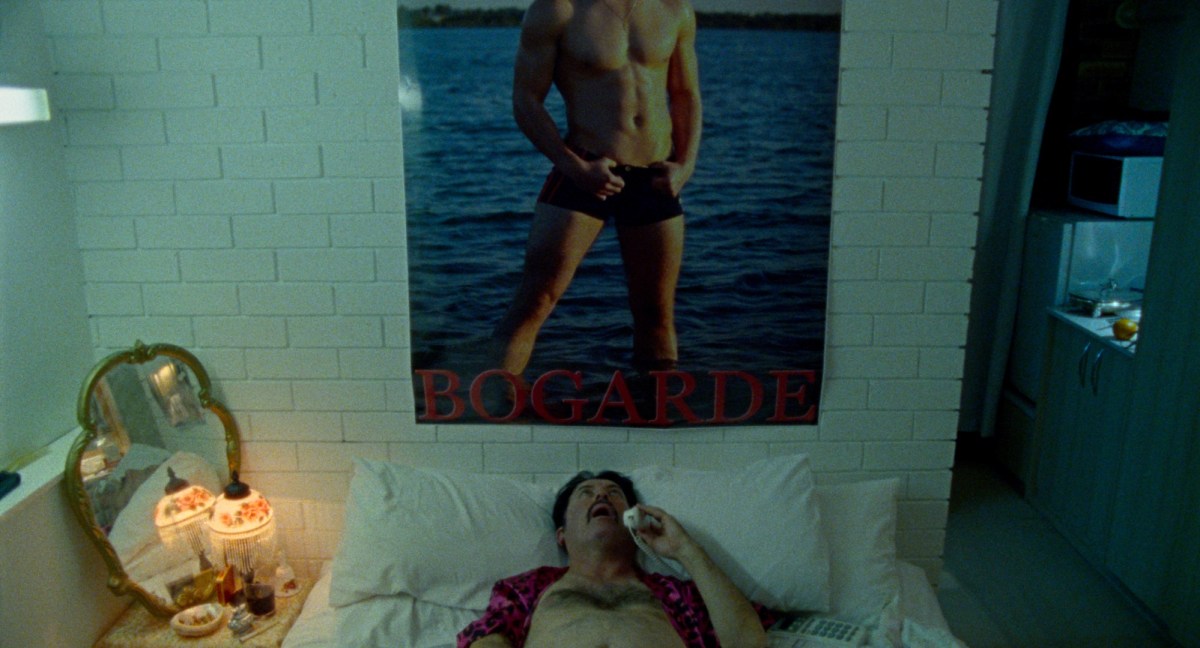
Scuzzy motels in cinema can’t help but summon David Lynch’s spine-tingling liminal spaces and pull back the shower curtain of Alfred Hitchcock’s Psycho (1960). Likewise, Phillip Philadelphia strips away the thin veneer of mundanity, in so doing opening an unnerving portal. Phillip’s unravelling, in this hopeless place, appears to soil the very fabric of reality.
Watch as Phillip’s seedy prosthetic nose appears and disappears, as if phasing at a vibration dogs can probably smell. Phillip’s pontificating is oddly poetic, with Briggs and Vagg bestowing dishevelled magnificence on this sorry character. He’s a marvellously unstable anchor in the vein of Federico Fellini’s 8½ (1963), Olivier Assayas’ Irma Vep (1996) and Rainer Werner Fassbinder’s Beware of a Holy Whore (1971), but far less productive.
Phillip’s not so much making a movie as a mess of everything. Lying spreadeagled in his dirty bed, below a poster of a bare-chested Antony frolicking in the surf, there’s little chance he’s going anywhere good. A creeping melancholy given a camp injection by Lauren Bright’s majestically messy belle, Maude Mercyside. A former lover of Phillip’s, her not-so-smooth moves will indulge another nasophiliac’s wet dream.
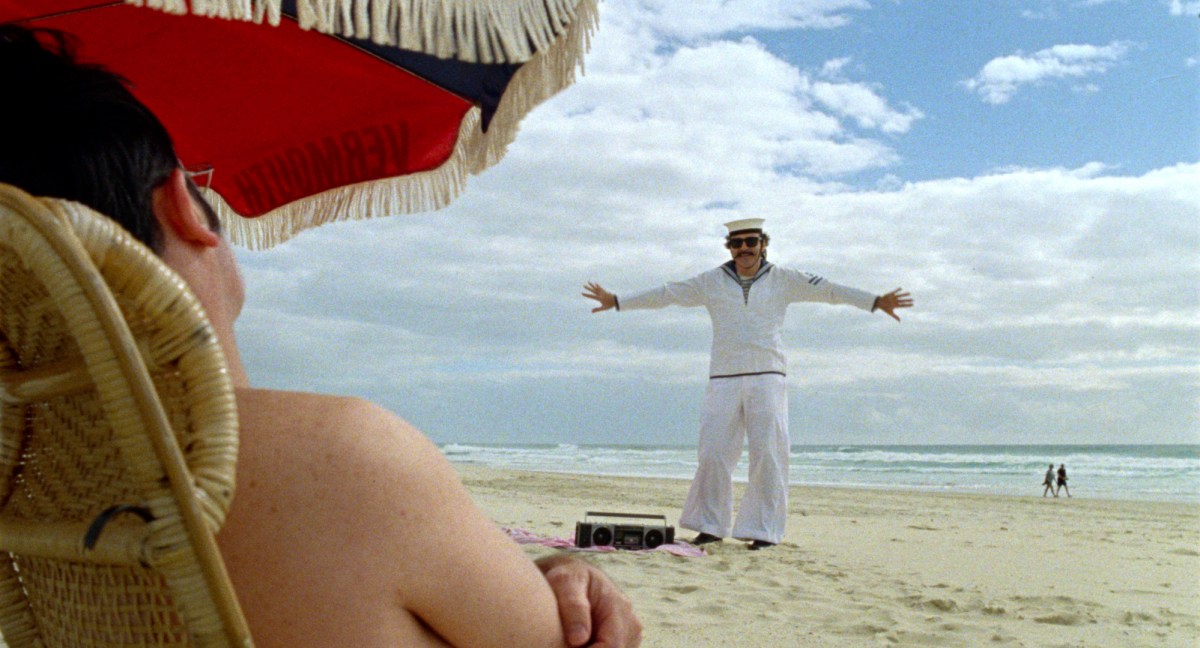
As much a vibe as it is a linear narrative, there are throughlines to Phillip Philadelphia’s madness. Briggs’ A Grand Mockery co-pilot Sam Dixon plays Buzz, a drugged-up bogan in the motel room next door who almost steals the show with arguably the most chaotic swimming scene set to film.
Pop star Sanfeliu appears as a saucy sailor (or does he?), lending the film its earworm signature theme that’s on-brand with the soapy melodrama Briggs’ appropriates, alongside the greats of Lynch and Pedro Almodóvar.
Watch the trailer
Apeshit
Shooting on luminous 16mm, Phillip Philadelphia cinematographer Adric Watson lends Briggs’ grubby disturbance a beguilingly mythic grandeur.
There are shots of the beach, with Avalon-like mists lolling over the waves, that somehow evoke the despairing cry into the abyss that closes Planet of the Apes (1968), goddam you all to hell. Vera Hector’s editing catches you between the cracks as the strange matter spills out.
Both an invocation of a lost paradise and a prosecution of colonial myths, the film opens with black-and-white newsreel of Queen Elizabeth II visiting Australia, with these intrusions interspliced with second world war bombers in flight, reign-ing down destruction, as it were.
Slippy, trippy and thoroughly quippy, particularly in the glory (hole) daze between Mercy and her fading lover, Phillip Philadelphia will disturb many and delight the right sort of sicko. Cum for the nose job, stay for reality’s decay.
Phillip Philadelphia screened at the Melbourne International Film Festival.
Discover more screen, games & arts news and reviews on ScreenHub and ArtsHub. Sign up for our free ArtsHub and ScreenHub newsletters.
Actors:
Oliver Cameron, Geoffrey Vagg
Director:
Adam C Briggs
Format: Movie
Country: Australia
Release: 07 August 2026