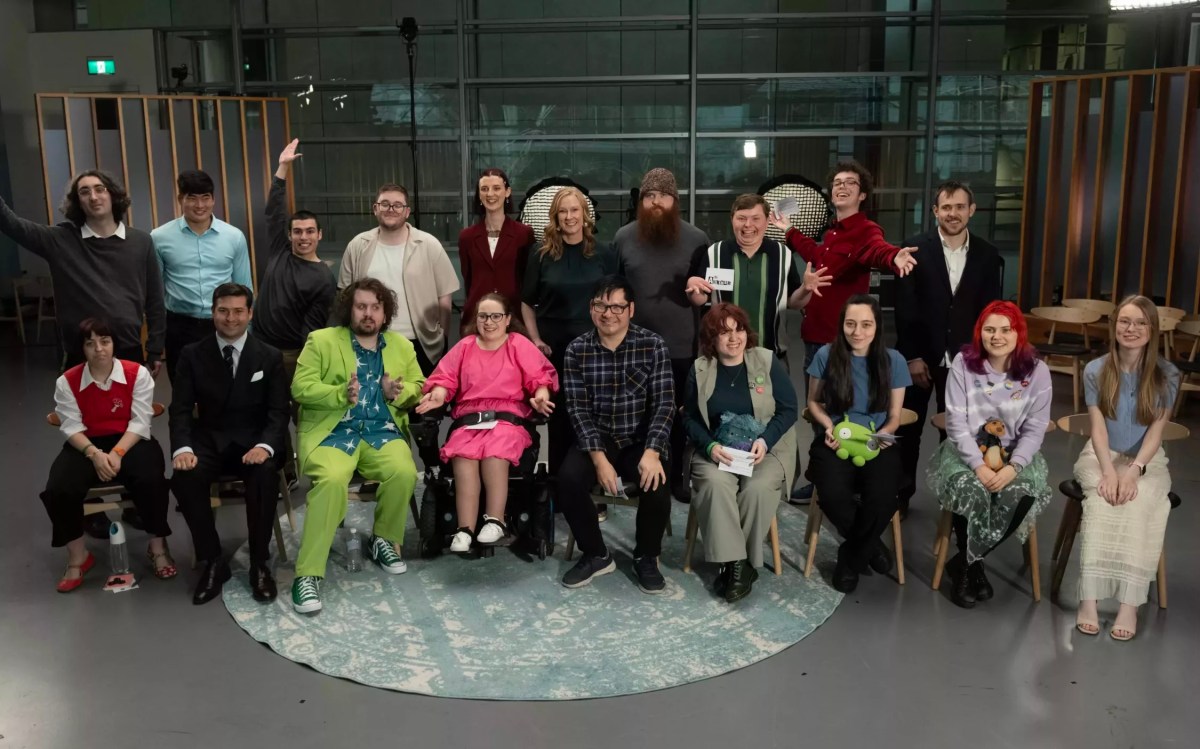
ABC series The Assembly has always been about creating news – at least, the celebrity interview kind of news. Each season a collection of Autistic journalism students is taken under the wing of mentor Leigh Sales and given the chance to get priceless work experience asking some of Australia’s biggest names the tough questions. But this year, the real news on The Assembly is about the show itself.
The 2026 season (the third) sees the graduates moving beyond simply conducting the interviews to hitting the road and researching their subjects in person. Visiting the locations that shaped the lives of the interview subjects, speaking to their close friends and family to get the inside story – as the press release puts it, they’re going to ‘tap into the origin stories of these famous Australians in a way that we’ve never seen before’.
Well, not unless you’ve ever seen Australian Story. Or you remember Julia Zemiro’s Road Trip. Or you’ve seen any one of a number of celebrity profile series, because this kind of format is one of the more reliable go-to’s of Australian television.
The Assembly: this year’s line-up
The Assembly isn’t exactly scoring interviews with recluses and icons either: this year’s line-up is Andy Lee, Claudia Karvan, Jimmy Barnes, Dave Hughes, Jessica Mauboy and Ian Thorpe. So if it’s not exactly breaking new ground, why the big shift?
One of the problems right from the start of The Assembly was the idea that the classmates would be receiving a realistic introduction to the world of television journalism. The premise is not that a collection of Autistic journalism students are brought into the ABC’s cadet system and given the exact same opportunities as every other would-be journalist; Leigh Sales isn’t out there mentoring radio cadets in regional NSW.
Instead, they’re brought in at the very top – conducting on-camera interviews with celebrities is the kind of thing the host of 730 does, not first-year cadets – and given experience doing a job that barely even exists on Australian television these days.
In the first season, that wasn’t really a problem; their future careers lay beyond the scope of the series. In the second season, the questions became a bit more obvious. If The Assembly was going to be training a half dozen or more celebrity interviewers each year, where were they going to find work? There’s barely half a dozen celebrity interviewers on Australian television, let alone on the ABC.
The Assembly: rewriting press releases?
The counter argument to that is that of course they’re not going to get jobs interviewing celebrities, but they are getting useful journalistic experience for when they … and then most people realise that interviewing celebrities has next to nothing to do with what a journalist, especially a cadet journalist, does every day. Here’s a clue: how much time do the members of The Assembly spend re-writing press releases?
Even interviewing someone for a news story is very different from talking to a celebrity. With a news story, you need the subject to give you specific information, which requires a very different approach to interviewing compared to trying to get someone famous to talk about themselves.
What talking to celebrities does do is make for interesting television. The students are a collection of unique and engaging people with their own compelling backstories. While the celebrities are almost always the kind that have been around long enough to know how to handle the spotlight, there have been a number of occasions where the questions have been interesting or unusual enough to get worthwhile answers – with the occasional Trump impression thrown in.
But clearly being good television isn’t enough; we have to see some career progression, some sign that the students are getting more out of this than the chance to appear on television. But by turning The Assembly into the kind of show the students would hope to move onto, it highlights an uncomfortable fact. At the ABC at the moment, due in large part to decades of cuts, career progression is barely a thing.
This isn’t a secret. Recent strikes at the ABC have been explicitly about the lack of career progression for staff. And it’s not hard to figure out why: how often does the host of 730 change? And then think about how many people must be next in line for that job, and how many are waiting on the next rung down, and so on.
The Assembly: the reality
The ABC is not a place where youth is given much cachet as far has high-profile jobs go, and older hosts tend to stick around. So unless brand new opportunities come up, up-and-coming journalists quickly find their paths narrowing. When a radio newsreader has had their job for a decade or more, at what stage does an up-and-comer realise they’re never going to get a shot?
The original promise of The Assembly was that the students would move on to jobs inside the ABC’s news arm and their careers would progress from there. The change in format for the third season is an admission that, for the majority of Assembly members, that’s not going to happen. There is no clear path for them to progress, and so the show has to change to give them the opportunities that the ABC in general can’t.
Which also raises another question. The press release says: ‘In its third season, The Assembly evolves into a deeper, more ambitious series, with Autistic journalism students from previous seasons returning to question some of Australia’s most recognisable personalities for revealing, in-depth interviews that go beyond their public image.’
If this season features returning students, where are the new students that have been inspired to give journalism a try meant to go?