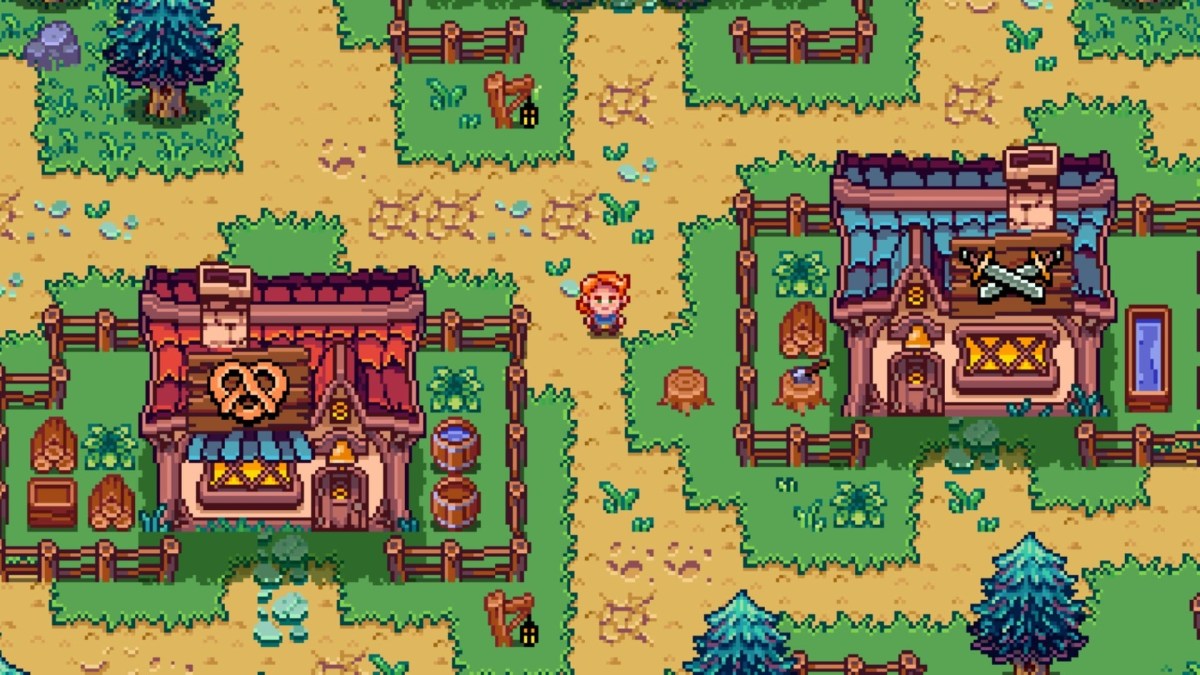
In 2024, games industry legend Ron Gilbert, responsible for iconic titles like The Secret of Monkey Island, Thimbleweed Park, and the Humongous Entertainment games (Freddi Fish, Spy Fox, Putt-Putt, Pajama Sam) revealed the first screenshots of an untitled RPG described as ‘classic Zelda meets Diablo meets Thimbleweed Park.’
Ron Gilbert’s lost RPG – quick links
What happened to Ron Gilbert’s RPG project?
At the time, this RPG project was aiming for a 2025 release, with plenty of enthusiasm around the announcement. Gilbert, as a veteran of the industry, had the clout and back catalogue to earn this excitement. And with a tagline combining three very well-regarded games, there was certainly high hopes for what was to come.
But as Gilbert recently revealed to Ars Technica, the project ultimately ended up being cancelled, as publishers weren’t willing to fund the game – even despite ‘Ron Gilbert’ being a household, well-respected name.
‘I just [didn’t] have the money or the time to build a big open-world game like that,’ he told the publication. ‘You know, it’s either a passion project you spent 10 years on, or you just need a bunch of money to be able to hire people and resources.’
While Gilbert pursued funding throughout the year, he told Ars Technica this simply wasn’t possible, as no publisher was willing to bet on something that wasn’t a ‘hot item’ at the time.
‘Doing a pixelated old-school Zelda thing isn’t the big, hot item, so publishers look at us, and they didn’t look at it as “we’re gonna make $100 million and it’s worth investing in,”‘ he said. ‘The amount of money they’re willing to put up and the deals they were offering just made absolutely no sense to me to go do this.’
‘The big companies, it’s like they just have formulas that they apply to games to try to figure out how much money they could make, and I think that just in the end you end up giving a whole lot of games that look exactly the same as last year’s games, because that makes some money.’
Briefly, the team considered a fundraiser via Kickstarter, as Gilbert had achieved significant success going this route to fund point-and-click-adventure, Thimbleweed Park. But according to Gilbert, this was no longer a viable path as the platform is seemingly considered ‘dead’ as a game funding tool.
After cancelling work on his RPG, Gilbert began developing Death by Scrolling
After a year working on his now-cancelled RPG, Gilbert finally called time on the project, and began developing new ideas. As he recently told ScreenHub, out of playful prototyping sessions, the idea for the newly-released Death by Scrolling formed.
‘I was messing around with a lot of different things,’ Gilbert said. ‘One of the things I was messing around with was infinite scroll. RPG-like fighting as the screen scrolls… so you had to keep up.’
Death by Scrolling shared a similar aesthetic to Gilbert’s lost RPG, but with its tighter scope and mechanics-based gameplay, it was a title that was able to gain publishing support, courtesy of Microprose.
In this journey to releasing Death by Scrolling, it appears Gilbert learned many lessons – not least of all that the publishing and funding landscape of video games has changed significantly over the last decade.
After years of working in the industry, producing a wave of iconic, well-received, and financially-successful video games, Gilbert’s publishing troubles will likely be a stark lesson for developers around the world. When even big name developers struggle to gather support, it’s clear publishing a video game is now tougher than it’s ever been before.