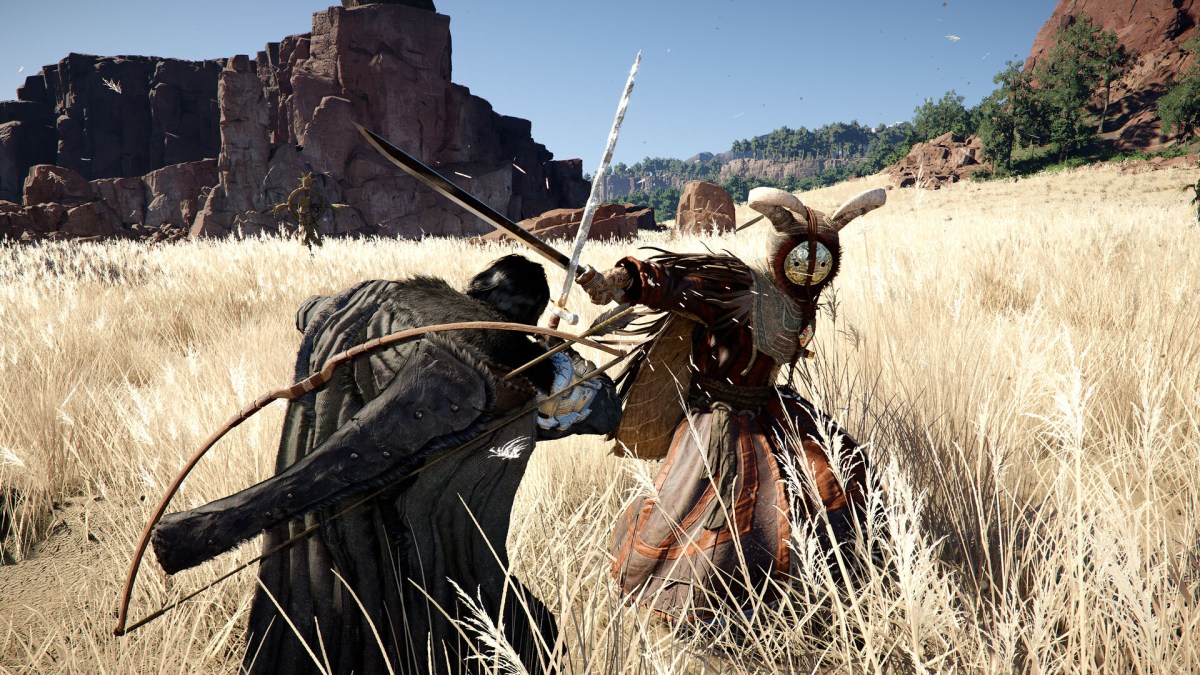
There’s an infamous moment where Bethesda director Todd Howard, introducing Skyrim back in 2011, motions towards a distant mountain in the game. ‘See that mountain? You can climb it.’ While it may have been a funny thing to brag about, I still get what Howard was going for.
Part of the fun of a huge open-world game is poking at the edges of the horizon, getting to the top of a mountain to see what’s on the other side, truly exploring everything the game has to offer. It’s in the idea that you’re really allowed to do whatever you want with this whole world that the developers have created for you.
Releasing this month, Crimson Desert has many mountains across the fantasy continent of Pywel, and yes, you can climb them.
Crimson Desert preview – quick links
Getting to know the sprawling world of Pywel
Despite the game’s name, I actually did not spend any of the six hours I spent playing a near-final build of the game in a desert. Instead, I walked around a castle town and surrounding villages, ran down neighbouring forest paths while occasionally stopping to fight enemy guards, and explored several more conceptual ‘nexus’ spaces, some of them high in the sky above the rest of the world, others in what I think might have been another dimension.
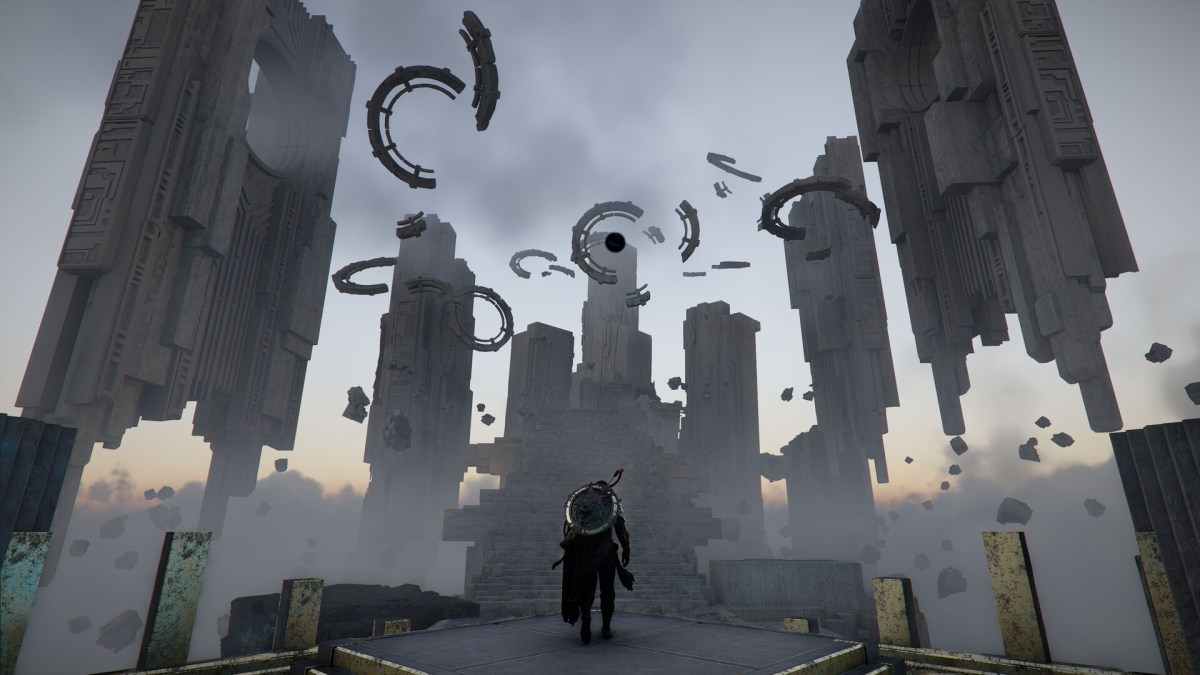
There are more than just mountains to climb here, and six hours with Crimson Desert feels like just a faint scratching of the game’s surface.
During my hands-on preview, I played through the opening four hours of the game before jumping through a series of later save files to test boss fights, traversal challenges and the game’s enormous open world with more late-game abilities unlocked.
I came away from my time with Crimson Desert still a little unsure of what the game is, but with a sense that there is a certain kind of player who is going to take to it in a big way. This is a game with strange jank, a bizarre structure and a wild number of things to keep track of, but it’s also excitingly ambitious and truly huge.
Kliff is a mysterious character in more ways than one
The game’s opening introduces us to our player character, Kliff, a large man who fights alongside his gang, the Greymanes, who I left the session knowing very little about. After some initial set-up, a huge fight breaks out between the Greymanes and the Black Bears, a rival group, which ends with Kliff – stabbed, shot and throat slashed – hurled into a river.
At this point, he’s somehow transported by some kind of mystical artefact to the ‘Corridor of the Void’ for a series of tutorials. Soon after, Kliff finds himself very much alive and living in a small fishing village, before setting off to a nearby castle for reasons that are, honestly, very thinly explained.
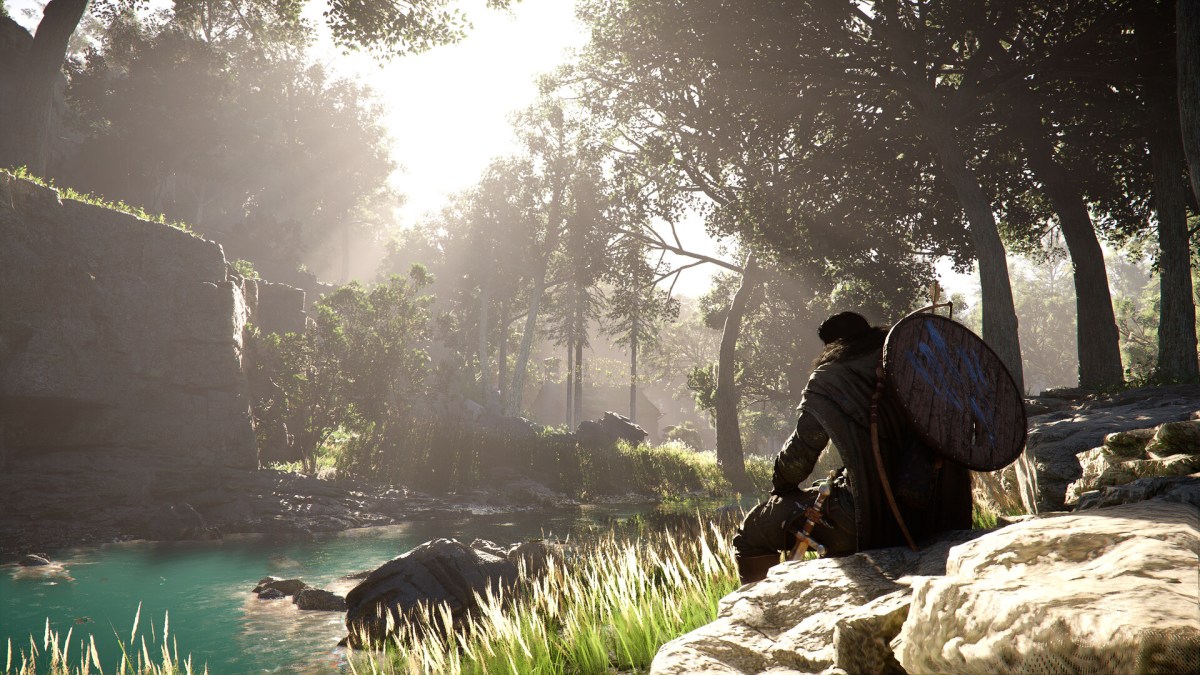
In this build, at least, Kliff never stops to wonder why he’s still alive, or why he keeps meeting characters who pull him in and out of portals. If I outlined everything I experienced over the first four hours of Crimson Desert in a strictly linear fashion, it would sound like a fever dream, and that’s kind of how it feels to play, too.
After each mission, the next objective pops up without any narrative prompting, and the game flits between involving you in the conflicts of its fantasy landscape and teleporting you away to mythical lands to solve puzzles without a real sense of structure. It was strange, being prompted to visit areas I’d never been to and talk to characters I’d never met, with no reason given.
Some very familiar references
This lack of narrative framework makes the game’s structure confusing. One moment you’re climbing on top of a house to clean out a villager’s chimney with a broom (once you figure out how to equip it) and the next, you’re on an island in the sky, using a sort of telekinetic whip to solve a physics puzzle, and it’s not clear if these two activities are ultimately related in any way.
The telekinetic whip-thing is fun though. As one of the developers explained to me, every interaction in Crimson Desert is physics-based, and you really feel this in ways good and bad. It makes puzzles more tactile but it also means that, say, jumping feels really weird. (While you can jump with a tap of the square button on a DualSense, it’s better to hold L1, point, and then press square to jump to a point – a slightly cumbersome system.)
Two hours in, I gained the ability to sprout wings while exploring a sky island, and when I jumped off to travel back to the lands below, the skydive animation was awfully familiar. The Legend of Zelda: Tears of the Kingdom is one of Crimson Desert‘s most obvious (and blatant) touchpoints, but there are many other examples of Crimson Desert cribbing from other games.
At one point, out of nowhere, my next objective was to liberate a stronghold, in a sequence that could have fit right into any number of Ubisoft games. The Witcher is another clear inspiration for the game’s setting and tone. There’s even a little Grand Theft Auto here: you can go on a killing spree, if you want, and guards will continuously track you down to claim your ever-rising bounty.
But then there are other parts of the game that feel a tad more off-beat. Right after liberating the stronghold, I had to follow a cat as it guided me to meet a wizard boy whose role in the story is hard to place. (Cats are everywhere in this world actually and you can pick one up and walk around petting it if you want to.) This was shortly after I learned a new magical ability, before being sent into a room containing a puzzle that, strangely, did not use it at all.
Hints at what’s to come in Crimson Desert
The Crimson Desert map is absolutely enormous. There’s an option to view it in terms of ‘factions’, which covers it in colours like a RISK map. How do factions work? I’m not sure – but I found that if I walked up to someone and pressed square to ‘greet’ them, I’d gain five points with their faction. (Pressing triangle to ‘kick’ them was also an option.)
The game is third-person by default, but you can shift into first-person and play from that perspective too. Based on the portion of my session where the full game was unlocked, there are additional playable characters to discover, as well as some crazy mounts. There isn’t anything in the first four hours that suggests you’ll eventually be able to plug yourself into a robot with a gatling gun and rocket launcher and fight various other robots, but you can.
There are dragons in Crimson Desert too. I did not encounter any enemy dragons, but I was able to take to the skies on one of my own, breathing fire down on enemies. In a game with so much going on, flying a dragon somehow feels par for the course. The mundane and the fantastical sit right next to each other here.
Complex skill trees and combat gameplay
Jumping ahead in Crimson Desert gave me a good preview of just how ridiculous your movesets get as you keep unlocking new abilities and leveling up on the game’s skill tree. As I attempted later boss fights, the developers at the event had to explain to me some of the new moves I’d unlocked that would be useful. There was one that gave me a Spider-Man like webswing, and another that let me fly high up and powerbomb back down into enemies: all very cool, but also difficult to keep track of.
The game really bombards you with abilities, some of them fairly unintuitive on a controller: juggling all of these moves in my head while also trying to dodge attacks was quite frustrating, although the developers assured me that, if I’d been playing for 30-odd hours and had learned these abilities along the way, it would all feel more natural. Which is probably true, but this feels like a game where you’re going to forget some of the abilities you’ve unlocked along the way.
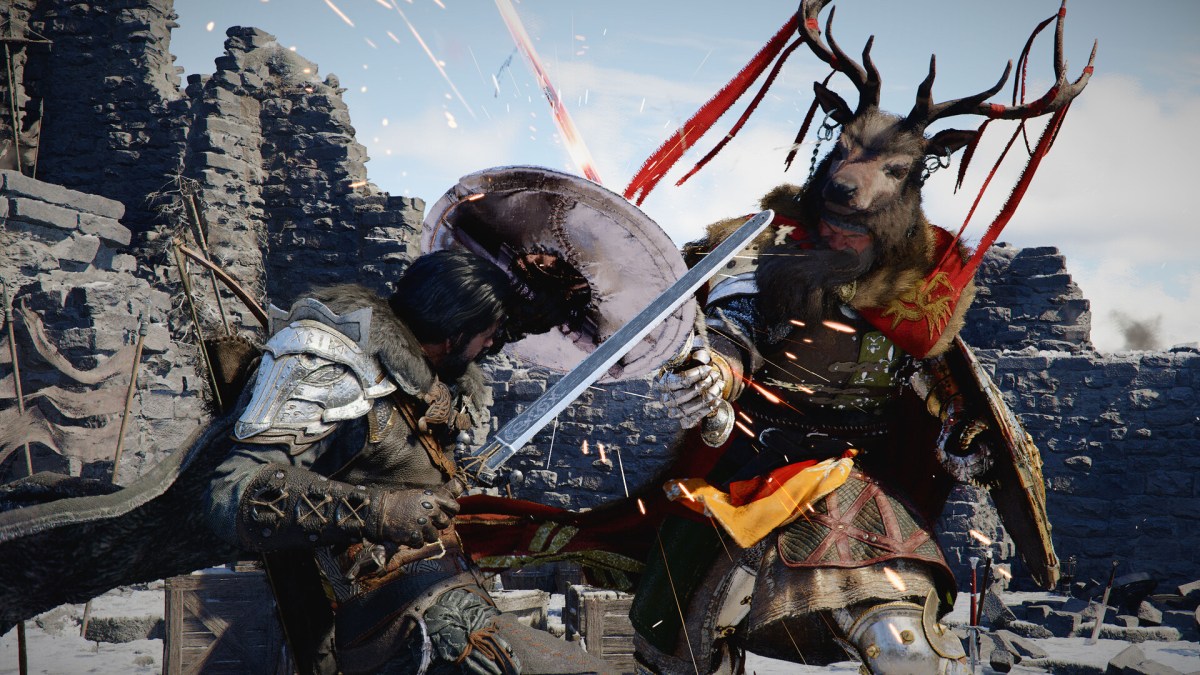
Combat is not always super fluid, but hacking through enemies with your sword, parrying and rolling, and occasionally switching to your ranged weapon, is mostly enjoyable. It’s fairly forgiving (outside of boss fights, which are much more challenging) but I liked testing out the new abilities I’d earned during puzzles to see how they worked in combat.
In truth, there actually wasn’t a lot of combat in the game’s opening – at one point I realised I had not fought anyone for over an hour – but based on my exploration of the whole map, it seems like there are far more hostile zones to explore across this world.
A little bit of everything and then some
What else happened? I wandered into a tavern and won an arm wrestling match, although it wasn’t really clear what purpose this had to the wider story. I found recipes and ingredients, and was told that there was a whole cooking system, but I never found a stove or pot. I found a helmet that let me watch events from the past play out in specific places, which seemed integral to the game’s storytelling.
I also visited an Abyss Gate, and an Abyss Nexus, and wasn’t totally clear on what the difference was. At one point I went on a killing spree, just to see if I could, and the game got so peeved at me that I continued to get notifications about how my standings had dropped with certain factions for a good 15 minutes. I collected ‘wanted’ posters for bounties, but never found any of them.
ScreenHub: Resident Evil Requiem review – a tale of two horrors
There’s a lot going on here. Crimson Desert feels like Videogame: The Videogame, mashing together every idea the team had, every mechanic the developers enjoyed in other games, every strange power-up or ability they could think of. But here’s the thing: I like videogames.
As weird and derivative and frequently janky as Crimson Desert can be, there’s something to how unabashedly game-y it all is. During my preview, I was often confused but never bored.
I do suspect that confusion may turn into frustration for some people when they play the game at home, without the luxury of having the developers in the room to remind them of the ability they unlocked an hour ago or to explain how a certain system works. But I also think there’s a certain kind of player who will really take to this game’s extraordinary ambition, the breadth of what’s on offer here, and the giddy pleasures of seeing what’s past every new peak.
I came out of my session with the game feeling like I could have written two completely separate previews, one of them largely positive, one of them largely negative, and they both would have felt true. One of the notes I wrote for myself while playing reads ‘trying to keep track of’ before trailing off into an empty line on the page, and that feels appropriate.
But perhaps the most encouraging thing I can say about Crimson Desert is that, thinking back on it a few days later, I’m keen to start again and learn more about what’s on the other side of those mountain ranges on the horizon. I know from my session that there’s robots and dragons and at least one boss that nearly made me pull my hair out, and I’m interested to see what else is out there.