Wuthering Heights – quick links
Emerald Fennell’s provocative adaptation of Emily Brontë’s 1847 novel Wuthering Heights leans into the essence of the source material, rather than replicating its literal plot beats.
If you’ve seen the trailer, you already know that this movie is marketed as ‘the greatest love story of all time’, presumably leading audiences to show up at the cinema expecting to witness passionate love, only to discover darkness, violence and misery in its place.
This is a move of marketing genius, because no one ends up in a toxic relationship on purpose – they show up expecting passionate love, only to discover darkness, violence and misery.
Wuthering Heights‘ marketing executes this bait-and-switch perfectly, as does the movie itself, cleverly leveraging audience expectation to provide a psychological experience that echoes the story’s narrative.
The film opens with creaks and moans, setting the audience up to expect something sensual, only to reveal the source of the sound as an act of violence. This sets the tone for the rest of the film, underlining the pleasure/pain dichotomy whilst utilising the power of subverted expectation.
Wuthering Heights: fear and comfort
Cathy and Heathcliff are children when we meet them, played by Charlotte Mellington and Owen Cooper, respectively.
Cathy is raised in a bleak world of cold dark spaces and paternal cruelty. Heathcliff is a frightened boy, brought into the household as an indentured ward on the drunken will of Cathy’s father, Mr. Earnshaw (Martin Clunes).
From a young age, each child is the physical canvas on which the other projects their emotional safety. The first interaction between Cathy and Heathcliff is one of fear preceding comfort, cementing their push-pull dynamic early on.
Mr. Earnshaw’s cruelty has long-lasting impacts on both protagonists, hinting at (without expanding upon) the intergenerational trauma at the heart of Brontë’s book. Cathy and Heathcliff are conditioned to elevate their abuser as a defence against his ever-present threat.
With protection and pain psychologically entangled, Cathy and Heathcliff grow up intensely enmeshed. Their unhealthy emotional dependence is the fulcrum at the centre of their relationship, upon which the whole plot balances.
The childhood-to-adulthood time-skip centres Heathcliff’s scars as a focal point for the transition, visually and symbolically drawing attention to the fact some wounds never heal. The adult versions of Cathy (Margot Robbie) and Heathcliff (Jacob Elordi) are significantly older than they were in the book, which undermines factors of emotional immaturity in the characters, but goes a long way in combating what might otherwise have made for some uncomfortable viewing later in the film.
When Cathy spends a few weeks at the home of their wealthy new neighbour, Edgar Linton (Shazad Latif), Heathcliff is bereft in the emptiness of her absence. Cathy returns transformed, in bright reds and stark whites, unnaturally bright against the shadowy blacks and blues of the decrepit Wuthering Heights, signifying a change.
Healthcliff’s hurt rejection of Cathy upon her homecoming wounds her deeply, catalysing a permanent wedge between them.
Wuthering Heights: obsession
When Cathy’s relationship with Linton escalates, Heathcliff leaves. Cathy retains an unshakeable belief in his return, and her obsession with him threatens to destabilise the good in her life, bringing her to the edge of a figurative and physical precipice.
Cathy’s eventual marriage to Edgar places her in the midst of grandeur and luxury. Immune to the love around her, Cathy is too comfortable, too warm, too loved, to recognise her own potential for happiness. The concept of supportive love is too foreign for her to connect with, and she pines for Heathcliff, unmoved by her own good fortune.
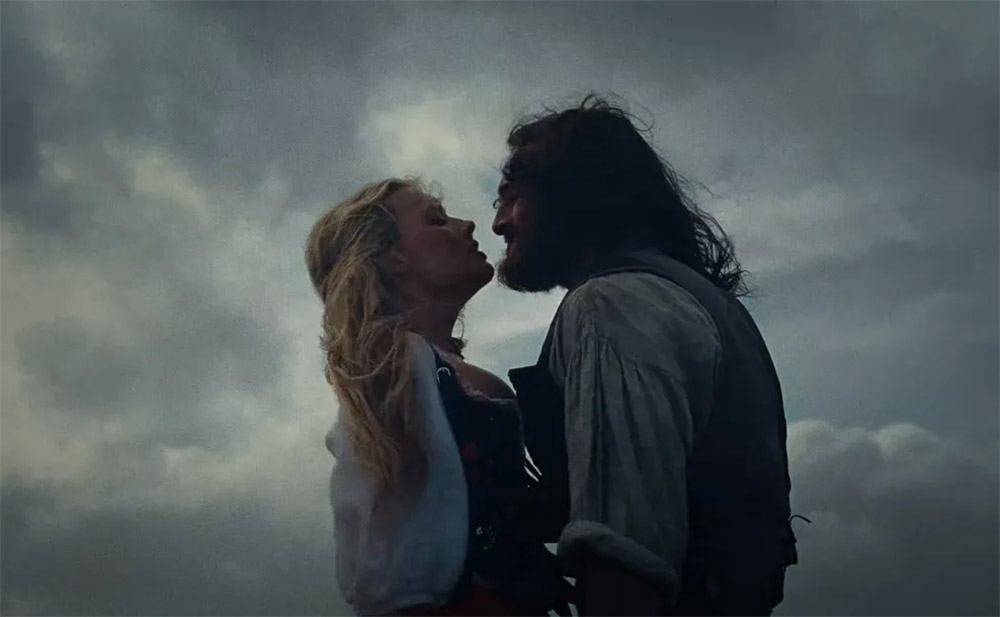
Like a majority of gothic classics, Wuthering Heights acknowledges marriage as a glittering but dangerous spectre.
This is never addressed in the film, but is subtly present in some moments, like the tightening of a bridal corset, and the way Cathy presents herself to Linton like a gaudily-wrapped present. However, unlike in other gothic romances, such as Charlotte Brontë’s Jane Eyre or Daphne du Maurier’s Rebecca, Cathy’s marriage to Edgar is actually a good one.
There are no secret attic wives or dastardly murder plots. Just continued support, adoration and stability, all of which fail to reach Cathy through her haze of longing.
Cathy snaps out her emotional dissociation when Heathcliff returns, and the familiarity of their push-pull toxicity awakens her fire. They are obsessed with each other, but too late to act on it, and seemingly doomed to catalyse their own – and each other’s – demise.
Equally compelled by the need to lash out vindictively when hurt, the depth of their reciprocal punishment is unfathomably self-destructive.
Wuthering Heights: Cathy
Margot Robbie’s portrayal of Cathy humanises, rather than pathologises, her notoriously unstable character, with moments of sweetness and palpable anguish in between instances of unnerving meanness and compulsive manipulation.
She brings warmth and depth to Cathy’s neurosis, without detracting from the flaws that precipitate the character’s destructive choices. A less capable actor – without Robbie’s capacity for nuance – might have ruined this film completely, but Robbie does justice to this tragic figure by virtue of her emotional range.
Jacob Elordi is appropriately rogueish as Heathcliff. There will undoubtedly be some anger at the white-washing of a character whose darker skin is highly relevant to the original plot. But there will also be those who commend the choice to refuse to perpetuate racist stereotypes, and will appreciate the refusal to perpetuate the connotations of a character whose route to villainy is directly associated with the colour of his skin.
Readers of Brontë who are dissatisfied with Elordi as Heathcliff are probably also familiar enough with the source material to understand why this adaptation prefers to channel the spirit of the book, rather than a literal retelling of every beat.
It’s easy to understand why retaining some elements of an almost 200-year-old novel may not translate well to modern audiences. Either way, Elordi’s performance more than makes up for the divergence from his character’s canon traits. He makes the role his own, and his skill facilitates the simultaneous perception of his character as both desirable and dangerous.
Cathy’s husband, Edgar, is easily the most underrated character. He essentially functions as a foil to Heathcliff, and is positioned as an obstacle to the love between the two protagonists. Shazad Latif perfectly captures the kindness and dependability of his character, who Latif infuses with an air of understated strength and quiet resilience.
Audience impressions of Edgar may function as an informal litmus test to their vulnerability to toxic relationships. Such people may perceive Edgar as a villain, standing in the way of true romance. But those who understand the difference between self-destructive infatuation and healthy stable love will find Edgar to be an utterly endearing and desirable character.
Alison Oliver is beautifully creepy as Isabella Linton, whose own tendency towards obsessive behaviour manifests in unusual ways. Isabella’s dynamic with Heathcliff represents a willingness to degrade oneself, and exemplifies the sadomasochistic elements of toxic relationships more concretely than any other character.
Oliver expresses Isabella’s naivety and self-degradation through uncanny sweetness with an unsettling edge. Oliver’s unique characterisation of Isabella is appropriate to the plot-changes between the Isabella of the book, and Isabella in this film. It is difficult not to like Isabella, even in her lowest moments.
Wuthering Heights: contrast
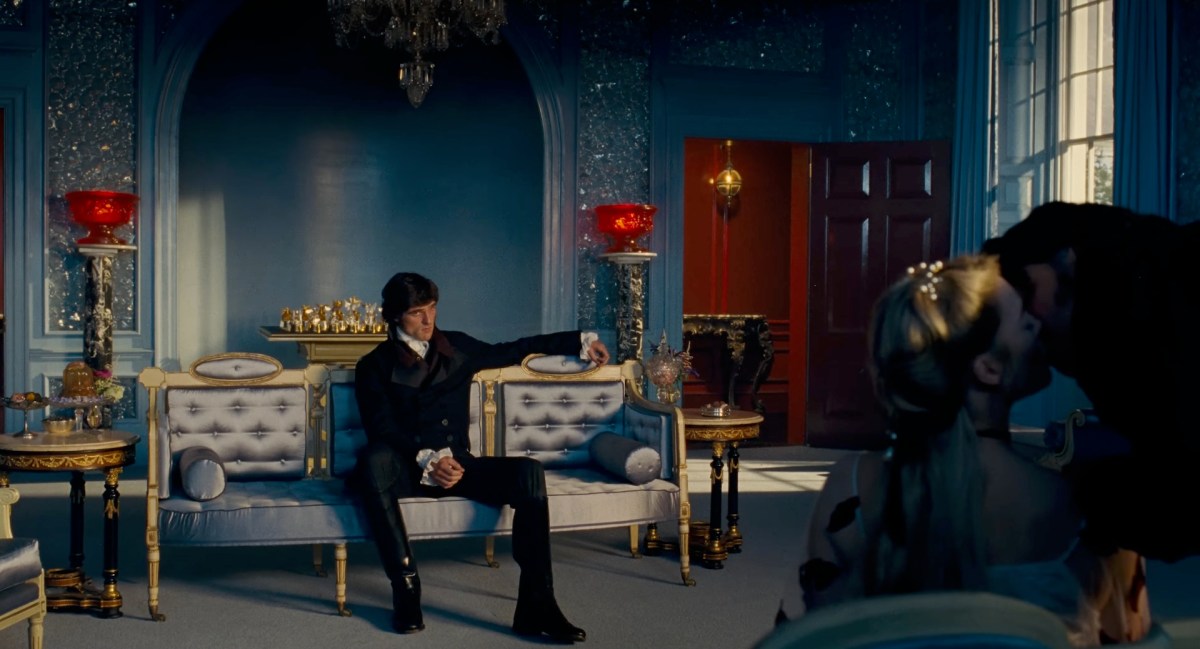
Contrast is key across the board, which serves to enhance the narrative whilst broadening the visual scope of the film. From the dark and uncanny (hanging dolls, dark shadows, wild moors, and dilapidated gothic settings) to the surreal grandeur of the Linton’s home (complete with glittering walls, blood-red floors, gold accents, and fleshy walls), the artistic choices are more aligned with implicit meaning than historical accuracy.
There are many layers of symbolism to unpick in the hyper-sylised set and costume design, which merges period pieces with modern fabrics and furnishings. Even those who value historical accuracy will appreciate the artistic value of these aesthetically-interesting and thematically-poignant choices.
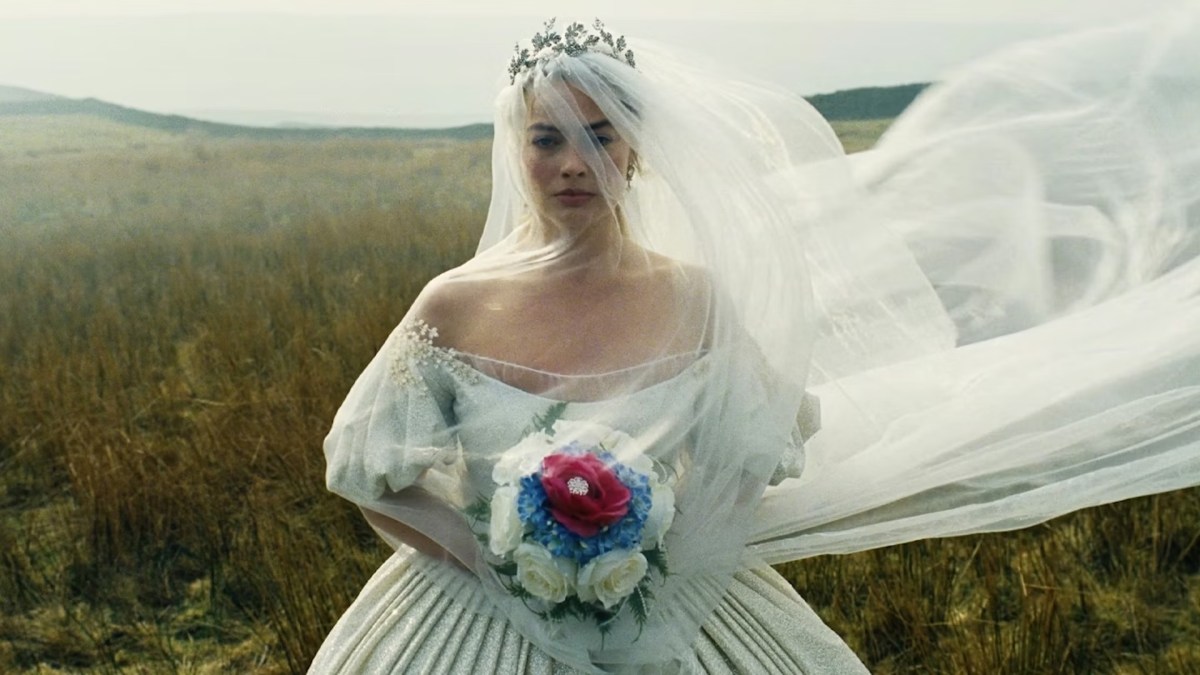
The colour and texture of the costumes are both evocative of the era and artfully anachronistic. Cathy’s costumes, in particular, are memorable, complete with diamante freckles, noose-heavy necklaces, and colour palettes that outwardly communicate internal states.
The film’s creative choices are not always practical, but they do create moments of iconic imagery. The scene in which Cathy – ghostly in gauzy white – floats across the moor towards her new life, demonstrates a preference for atmosphere over accuracy. Narratively, this scene makes no sense, but the aesthetic impact makes the choice justifiable.
In this film, supposedly incidental imagery is rarely incidental. For example, one specific scene (in which a hanging occurs) highlights a grotesque celebration of the darker side of human nature through creepy props and unsettling backgrounds.
Punch and Judy shows, sinners for sale, demonstrations of blood-lust, and a sign proclaiming the jealousy of the lord all depict the human tendency to glorify violence, idealise vengeance or find arousal in the objectively repellant.
The cinematography communicates through composition, lighting, and colour as much as the script communicates through dialogue. Red – the colour of blood, love, passion, destruction, and sunsets (for people to ride off into) – is featured heavily, often set against stark white, or juxtaposed against dark shadows.
Wuthering Heights: sensory detail
Like Emily Brontë’s writing, the cinematography prioritises sensory input and environmental detail. From the constant rain, howling wind and fog so thick it is impossible to see what lies ahead, to viscous close-ups and evocative framing, every shot is artful and full of contrast.
Time and time again, love is depicted as violence and violence is depicted as love, mimicking the mindset of toxic dependence. This manifests both subtly and overtly, from the sweetly vicious destruction of furniture, to moans of exertion (‘Harder, harder, oh yeah’) as a character butchers an animal.
One could describe this film as being the story of a troubled man who gets his ego bruised by perceived rejection and responds by plotting to destroy his lover’s life. But that would be reductive, and would not do justice to this emotionally complex narrative.
Long-perceived as literature’s favourite problematic pair, this interpretation refuses to judge its characters for being flawed human beings, centring their perception of their relationship rather than the truth of it.
Wuthering Heights: Heathcliff the incel?
Is Heathcliff the original incel? No. He’s just one of many in a long line of literary man-babies with poor self-regulation. But this is hardly the point. The focus of this adaptation is the ambiguity inherent to abusive relationships, and how easy it can be to slide into self-destructive madness. Whether or not Heathcliff and Cathy actually love each other is irrelevant.
There is love in this movie, albeit twisted by obfuscation, bitterness, posturing and jealousy. There is a reason this story continues to resonate after all these years. Loneliness, otherness and trauma can easily lure people into giving themselves unbridled permission to wallow in selfishness, pettiness, vengeance and other byproducts of the human condition.
They can fool themselves into confusing violence for passion. They can remain numb to their own potential for happiness in favour of embracing toxic obsession. Wuthering Heights explores all of this, without condemnation or idealisation.
Love doesn’t torture these characters. Their torment stems from disproportionate reactions to thwarted expectations, borne from deeply-ingrained coping mechanisms. These characters self-destruct when they lack the emotional literacy to acknowledge reality, clinging to their own delusions and bending to their own whims rather than taking accountability for their emotional damage.
Classism and racism are baked into the book, and this film presumes a level of audience awareness of this. But it takes the emphasis off social prejudice as a main source of Heathcliff’s emotional damage, and places it squarely into the realm of the personal.
Power dynamics are still an important element of the story, and this is explored to an extent without centring it as a major theme. Whether this is motivated by social responsibility, or the knowledge that mainstream audiences will relate more to the toxic personal dynamics between characters than the subtleties of nineteenth century class hierarchies – is unclear.
Without spoiling the plot of the film, it’s safe to say it doesn’t completely follow the book. There are entire characters and sub-plots absent in this re-telling, but the core of the story is there.
There are hidden layers of emotional depth to this adaptation, which boasts artistic merit, stunning cinematography, magnetic performances, and complex themes lurking in the shadows of surface-level melodrama. Provocative, suggestive and sadomasochistic, this is Wuthering Heights for a new generation.
Fans of classic literature are well aware of the fact that ‘romance’ and ‘gothic romance’ are not even close to being synonymous terms. The book is not a love story, and this film is not romantic.
But disguising it as such is a clever way of emphasising the oft-blurred line between care and abuse. Being gaslit into perceiving oppression as protection, jealousy as loyalty, or vengeance as passion is built into many abusive dynamics.
Hijacking expectations to control the audience’s emotional lens is an impressive feat that applies to the movie itself, as much as it does the marketing.
Don’t see this movie expecting it to be ‘the greatest love story of all time’, because it’s not. But it might be one of the most moving tales in classic literature, uniquely expressed in hyper-stylised, meta-referential, cinematic glory.
Wuthering Heights is in cinemas now.
Discover more screen, games & arts news and reviews on ScreenHub and ArtsHub. Sign up for our free ArtsHub and ScreenHub newsletters.
Actors:
Margot Robbie, Jacob Elordi, Hong Chau, Shazad Latif
Director:
Emerald Fennell
Format: Movie
Country: USA, UK
Release: 13 February 2026