Here’s a philosophical game design question for you.
Say you’ve made a racing game, and it contains three difficulty levels – a story-focused mode, a balanced mode, and a challenging mode. And let’s say that there’s a player out there who might switch the game down to its lowest difficulty, because they’ve just failed a mission objective (‘finish in 3rd or above’) several times in a row, and they need to progress the story but they’re getting frustrated. They’re not amazing at the game, but they’re also not that bad, and the race itself just isn’t interesting enough to be worth this level of time and effort.
Now, let’s say that this player – who looks a lot like me – has just pulled off a fantastic slide with a boost around the final corner on the last lap, securing third place, and now just needs to gun it down the final straight to proceed.
The AI-controlled car that is now in fourth, the one that has its difficulty set to ‘as easy as possible’ – should they stay there, as long as the player character does not mess up? Or should they activate their boost now, overtake the player, and make them start the whole race again for the seventh time?
Playing Screamer on its easiest difficulty sometimes feels like playing with an older sibling who has been instructed to let you win, but absolutely cannot help themselves, and keeps taking corners flawlessly at high speed before activating the timing-dependent extra-powerful boost to zoom off into the distance.
This aspect of the game will likely change over time – already over the review period a patch dropped to balance some of these issues, with another promised soon after launch – but the version of Screamer I played really knew how to make me swear.
Screamer – quick links
Screamer: more than sulking
This isn’t just me having a sulk about not being very good at Screamer, the new anime-tinged arcade racer from veteran racing developer Milestone – this is symptomatic of the game’s wider issues, and its inability to really commit to itself.
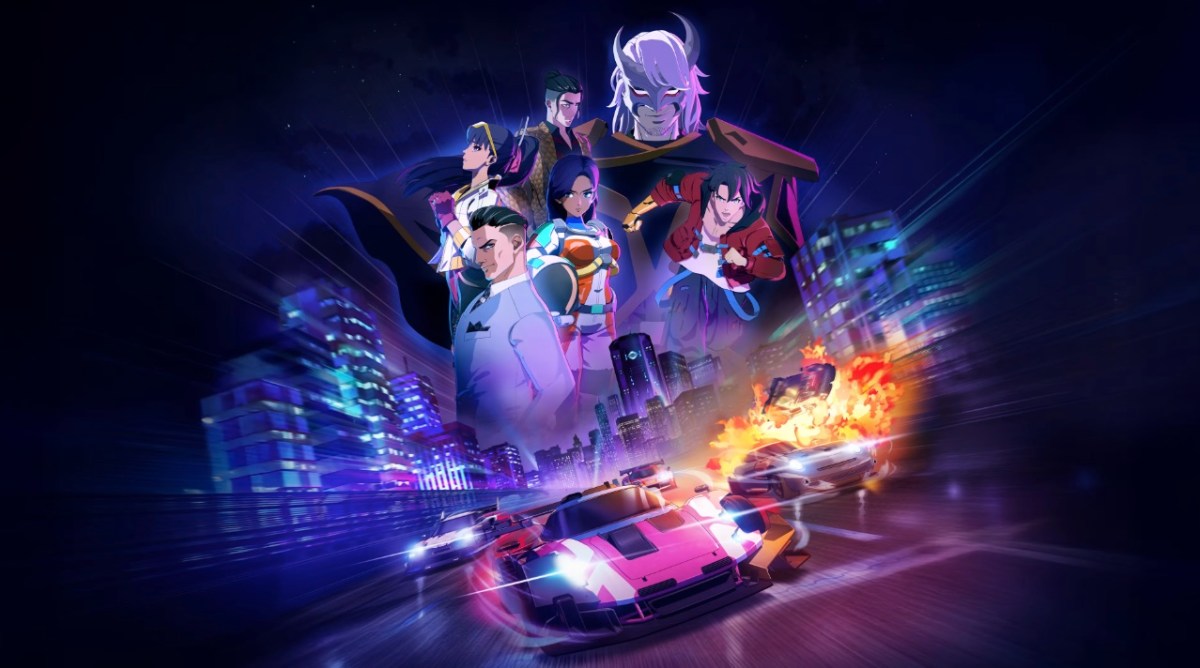
Screamer wants to be a story game about an elite racing league of multinational anime characters, a fun, slick arcade racer with a lot of sliding around corners, and, intermittently, a vehicular combat game. But so often, the game gets in its own way, with a drawn-out story and racing that’s much more vanilla than I expected.
Throughout the single-player story campaign – and within the various different modes in the game’s Arcade menu – you play as several entrances into the Screamer tournament, a big racing competition where cars, powered by a mysterious ‘echo’ ability, race for domination.
There’s a larger plot here, involving over a dozen racers and their various personal vendettas and histories, which is told throughout long pre-race portrait discussions and occasional cutscenes.
The story is, unfortunately, forgettable. It has the feeling of a soap opera that you’ve dropped in midway through, one where the characters are extremely broad and their conflicts are difficult to keep track of.
It means that when you’re playing through the campaign, these constant story scenes become a thing to endure rather than enjoy. You can feel the budget constraints here, with limited, weirdly small character portraits and repetitive static backgrounds making the story difficult to invest in.
I did enjoy the fun detail of the characters speaking multiple different languages (it’s explained that they’re all outfitted with automatic translators), but that’s just a bit of flavour on a story that is otherwise quite dry.
Screamer: on the track
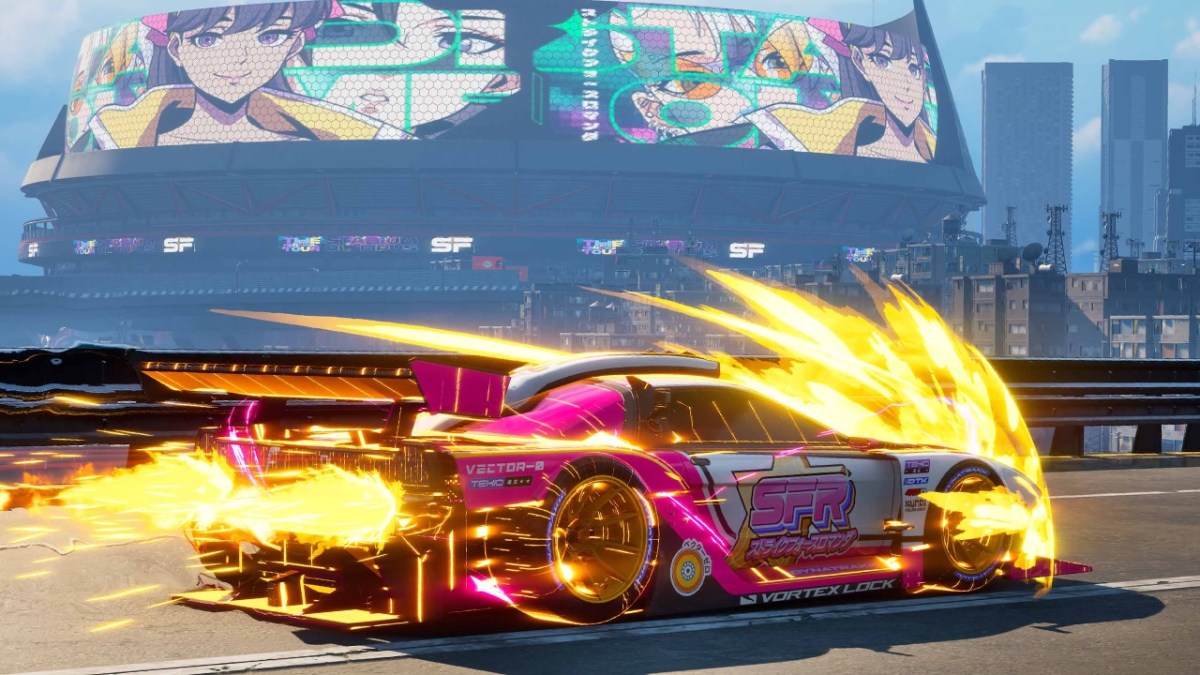
How does this story factor in once you’re on a track? It doesn’t. For a game that is pushing so hard to have a lot of personality, it’s strange that there is no dialogue, no anime-style visual cut-ins, and no real sense of style on the track.
Races look and feel, for the most part, like any race from any low-to-mid budget arcade-adjacent racer from the last 15 years, and the race objectives rarely overlap with what was presented in the preceding cutscene in any interesting ways. The sense of visual style you see on the menus and in the cutscenes does not carry over – the backgrounds are often a little bland.
Nothing explodes, or crashes into the track, or changes your course mid-race; even shortcuts are extremely rare.
The racing model itself has one big interesting idea – drifting is handled by the right stick, and operates independent of your steering. This means that when you come up on a lovely long corner, you can drift into it without touching the brakes, and doing a perfect drift around a corner can be quite satisfying.
This is Screamer‘s best feature, and because of it I had some good times playing through time trials and checkpoint challenge races in Arcade mode, trying to nail good racing lines and figure out the best ways to drift without losing speed.
Races are, otherwise, pretty standard, thanks to some boring track designs and a few more annoying mechanics. When you hit an appropriate speed and the bar by your speedometer fills up, you can tap L1 to shift up a gear and go faster. But when you slide – which you will, a lot – you’re often bumped down a gear or two, and the bar fills up again very quickly. What this means is that if a track is sufficiently twisty, you are constantly feeling your controller rumble and needing to tap L1 to shift up. It gets monotonous quickly.
Boosting is on the same button; you hold L1 down and release it at the right time once you’ve filled up your gauge by driving at high speed. All well and good, but the game’s cluttered UI meant that I was frequently trying to boost mostly on vibes rather than tracking when I actually had boost stored up.
In some modes, you can also accumulate power that is channeled into strikes, a straightforward rush attack that can briefly destroy a car right in front of you, or Overdrive, which sends you into a high-speed killing frenzy. These mechanics are fun ideas, but the game never feels particularly balanced towards proper combat; more than anything, striking an enemy and watching them blow up made me wish for another Burnout game.
Screamer: half measures
Screamer is a game of half measures. It’s got an anime style that doesn’t extend beyond the menus and cutscenes, a cool drift mechanic that isn’t put to good use by the dull track designs, and a long story campaign that just doesn’t hang together in an interesting way.
It feels like a game where the final product perhaps isn’t what the developers set out to make, or where restrictions have prevented it from realising its potential. It’s a shame – a story-focused, anime-style racing game with cool drifts and deep interpersonal conflicts between a diverse cast could have really been cool.
As it stands, Screamer is screaming for some significant tweaks under the hood before it’s totally roadworthy.
Screamer is released for Windows, PlaySTation 5 and Xbox by Milestone on 26 March 2026.
Discover more screen, games & arts news and reviews on ScreenHub and ArtsHub. Sign up for our free ArtsHub and ScreenHub newsletters.
Developer
Milestone
Publisher:
Release Date:
26 March 2026