Camp Miasma: how indie director Jane Schoenbrun made the jump to A-league casting

With Teenage Sex and Death at Camp Miasma, the rule-breaking filmmaker and trans hero Jane Schoenbrun has surprised us yet again.
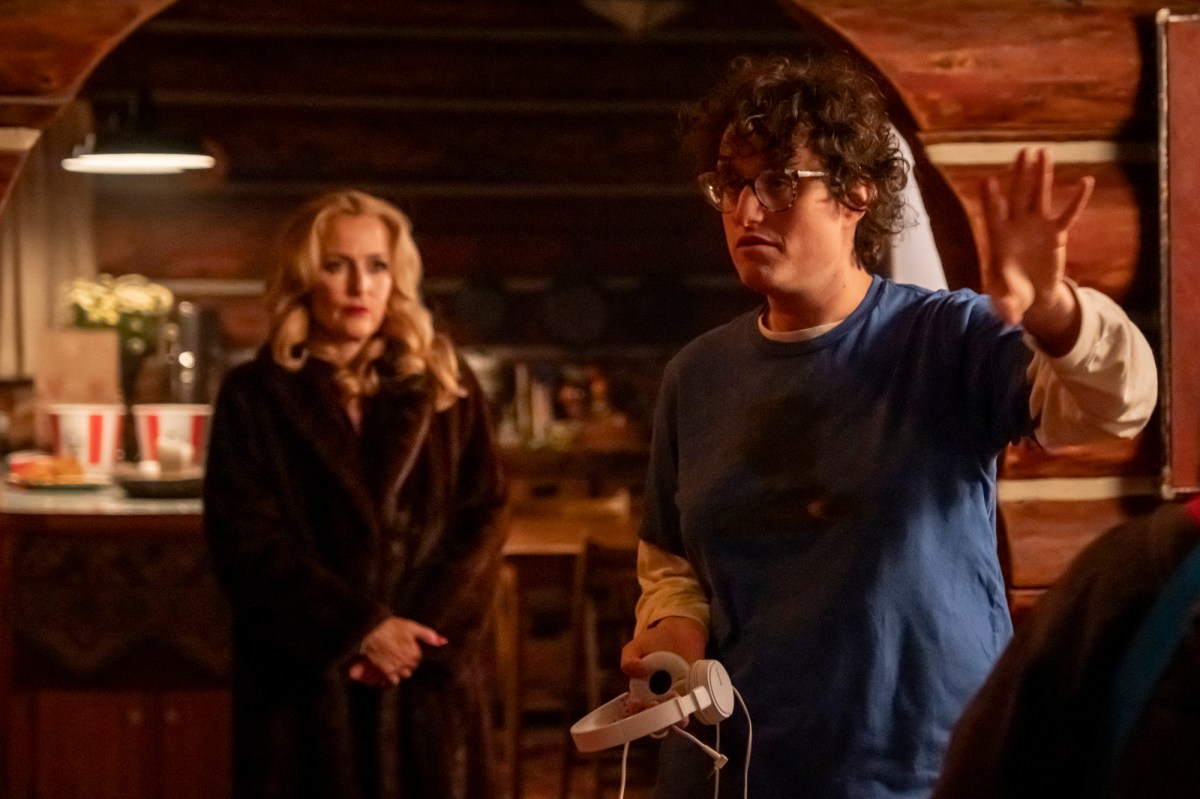
Gillian Anderson and Jane Schoenbrun on the set of Teenage Sex and Death at Camp Miasma. Image: MUBI / Madman.

There may be a decade and a continent between our origins, but triumphant Teenage Sex and Death at Camp Miasma directorJane Schoenbrun and I share a mutual adoration of Gillian Anderson.

I stuck a poster of The X-Files star to the wall of my poky halls of residence room at Glasgow University. This being the 90s, it was one of those Athena-style, vaguely saucy greyscale numbers – all Scully, no Mulder required.

As I was in the process of coming out, it wasn’t a lust thing so much as a shrine. A place to worship a luminously beautiful in every way talent, as chimerical on-screen as Marilyn Monroe herself, a goddess with the wisdom of Athena.

I was obsessed. Schoenbrun was too. We all were. We still are.

But how did the queer filmmaker leap from their low-key debut feature, We’re All Going to the World’s Fair, to casting The X-Files icon and Hacks star Hannah Einbinder in their latest, the fabulously camp slasher deconstruction Teenage Sex and Death at Camp Miasma?

Talent, in embarrassing abundance.

Blood magic

Anna Cobb In We're All Going To The World's Fair. Image: Dweck / Flies Collective.
Anna Cobb in We’re All Going to the World’s Fair. Image: Dweck / Flies Collective.

The release of We’re All Going to the World’s Fair in 2021 signalled a unique voice that spoke to fandom, fantasy and the relative freedom of online spaces in a naiver age – online places that allowed a generation of queer and non-binary kids to explore their emerging identity at a safe remove.

A surprisingly tender spin on the found-footage horror subgenre, World’s Fair starred Anna Cobb (Bones and All) as lonely teenager Casey. Embracing a viral trend, Casey repeats the phrase ‘I want to go to the World’s Fair’ three times, pricking her finger and smearing it on her laptop screen – an act of old blood magic for a new age.

It’s said that participants’ bodies will begin to mysteriously change, a clear echo of transitioning. Borrowing YouTube ASMR stars, World’s Fair also subverts expectations of stranger danger. An older, unseen avatar, JLB (Michael J Rogers), coaches Casey from a seemingly supportive, rather than predatory, perspective, though the line can admittedly be fine online.

Schoenbrun’s debut cast a beguiling spell. Though it was shot on a shoestring budget, it was impressive enough to land a coveted berth at Sundance, with the director nominated for the NEXT Innovator Award. But while World’s Fair demanded attention, it was Schoenbrun’s spooky sophomore feature, I Saw the TV Glow, that really blew things up.

The glow up

I Saw The Tv Glow. Image: A24.
I Saw the TV Glow. Image: A24.

I Saw the TV Glow cast Jack Haven and Justice Smith as high school outsiders Maddy and Owen, who find solidarity in their shared love of a Buffy-adjacent fantasy show called The Pink Opaque. When Maddy goes missing and a decade passes before she mysteriously returns, the boundaries between fact and fiction weaken.

Maddy claims to have been inside the show’s in-between space, the Midnight Realm, encouraging Owen to join her there. Again, identity and belonging are rendered as mutable in an allegorical nod to transition. Maddy and Owen pass from one realm to another while facing the threat of Mr Melancholy, a queer trauma stand-in if ever there were.

Returning to Sundance before bounding to Berlinale, I Saw the TV Glow was nominated for a coveted Teddy Award causing a sensation, particularly among younger-skewing audiences that grew up very online.

With Schoenbrun’s star in the ascendant and a proven popular record for packing folks into films unshackled from stuffy three-act structures and linear narratives, it’s not rocket science they can now sign major stars like Anderson and Einbinder.

Slash fiction

Teenage Sex And Death At Camp Miasma. Image: Mubi / Madman.
Teenage Sex and Death at Camp Miasma. Image: MUBI / Madman.

Bringing sapphic magnificence, Anderson shares the role of Billy Presley, a Norma Desmond-like reclusive movie star, with Amanda Fix, who plays her younger self.

Billy played Squeak, the final girl of Camp Miasma, the film-within-a-film in the vein of classic 80s slashers like Friday the 13th and Sleepaway Camp. But Billy rejected calls to return for the sequels, retreating into obscurity, residing in the summer camp from the OG movie.

ScreenHub: Gillian Anderson and Hannah Einbinder on Camp Miasma

Einbinder’s Kris, an indie filmmaker with shades of Schoenbrun, arrives here in a rental car, hilarious GPS joke included. She’s been tasked with rebooting the long-dormant franchise and has made bringing Billy back her entire identity, having experienced a powerful awakening while watching Squeak in peril as a kid.

Borderline asexual, Kris dissociates from her body during sex – ‘My primary partner tends to be my work’ – but nevertheless feels an erotic pull towards Billy, on spending the night in her cabin in the woods.

But this being a Schoenbrun film, even if deliberately more comically accessible, things aren’t quite what they seem. Little Death, the franchise ‘monster’ with a tragic queer backstory that wouldn’t fly these days, rises once more, as the film’s internal fiction refuses to stay separated from notional reality.

Watch the trailer

From Little Death to la petite mort

Anderson and Einbinder are magnificent sparring partners, making sweet love over a mountain of lollies and southern-fried chicken paired with highly suggestive dipping sauce. Radiating off-the-charts eroticism, their heat’s underlined by a sly nod to David Lynch’s reality-blurring lesbian noir, Mulholland Drive.

Queerness is not subtext here.

Teenage Sex And Death At Camp Miasma. Image: Mubi.
Teenage Sex and Death at Camp Miasma. Image: MUBI / Madman.

Schoenbrun has captured lightning in a bottle with this megawatt casting. They also keenly grasp the power of economic storytelling, actively resisting two-screen doomscrolling by relying on visual gags with inner monologues you must read on the leads’ faces.

Accompanying Alex G’s John Carpenter-homaging synth score, Camp Miasma’s suitably poppy soundtrack kicks off with a knowing wink via Okay Kaya’s dreamy R.E.M cover, Nightswimming. ‘I’m not sure all these people understand. It’s not like years ago, the fear of getting caught.’

The wicked fun opening credit montage sets the scene superbly, with posters and promotional material for the original Camp Miasma juxtaposed with morally outraged news clippings from the usual suspects: religious groups, censors and activist parents.

Teenage Sex And Death At Camp Miasma. Image: Mubi / Madman.
Teenage Sex and Death at Camp Miasma. Image: MUBI / Madman.

As the original’s buzz gives way to the stinking creep of late-stage capitalism, the sequels petered out and Little Death became both a bobblehead and a government safety campaign. Oh, the indignity.

There are nods galore to real-world final girls and the films that propelled them into our collective consciousness, as Schoenbrun gleefully adopts all the tropes, including underwear-clad escapes, with Kris gleefully embracing, ‘Tits bouncing as I run for my life’.

Cannibalistic studio bosses and their anti-woke agents will be skewered by Little Death’s phallic spear for dissing Billy’s legacy. The fourth wall will crumble, as Kris turns to camera and says, ‘I feel like there’s about to be a jump scare’. Generational viewpoints clash, when Billy responds to Kris’s poly girlfriend (Quintessa Swindell) having a boyfriend (Aren Bucholz), ‘Oh, kinda like cheating’. There’s even a stand-up-in-your-cinema-seat salute to Nicole Kidman’s AMC ad.

Sexy, scary and sharp as a tack(ing monster), this isn’t IP-resuscitating nostalgia weaponised for mass box office, though I’ve no doubt Teenage Sex and Death at Camp Miasma can and will do extremely well, particularly with the Carrie-like image of a blood-drenched Anderson and Einbinder arm-in-arm.

Schoenbrun has harnessed the inherently queer bones of horror, its mighty women and othered monsters, breaking and remaking slashers and forging them into something exhilaratingly new in their alternative worlds image. In so doing, they transform their fascination with Anderson and the very art of final girls into a lacerating love letter that bleeds pure undying brilliance.

Teenage Sex and Death at Camp Miasma is in Australian cinemas from 6 August.

Discover more screen, games & arts news and reviews on ScreenHub and ArtsHub. Sign up for our free ArtsHub and ScreenHub newsletters.

Stephen A Russell is a Melbourne-based arts writer. His writing regularly appears in Fairfax publications, SBS online, Flicks, Time Out, The Saturday Paper, The Big Issue and Metro magazine. You can hear him on Joy FM.