
The following article contains spoilers for Eddington.
Ari Aster has never been one to shy away from weird metaphors. From cults (Midsommar) to suffocating mothers (Hereditary, Beau is Afraid), his horror films have always interrogated the forces that hold us captive. His latest flick, Eddington, takes aim at another force altogether: technology.
Oh, and there’s a Magikarp in it, for some reason.
Eddington follows a fictional New Mexico town during the early days of the COVID-19 pandemic, where political divides and conspiracy theories tear through the community. Joaquin Phoenix stars as sheriff Joe Cross, a man desperate to hold onto some semblance of order while clashing with the town’s mayor, played by Pedro Pascal.
Eddington and SolidGoldMagikarp: quick links
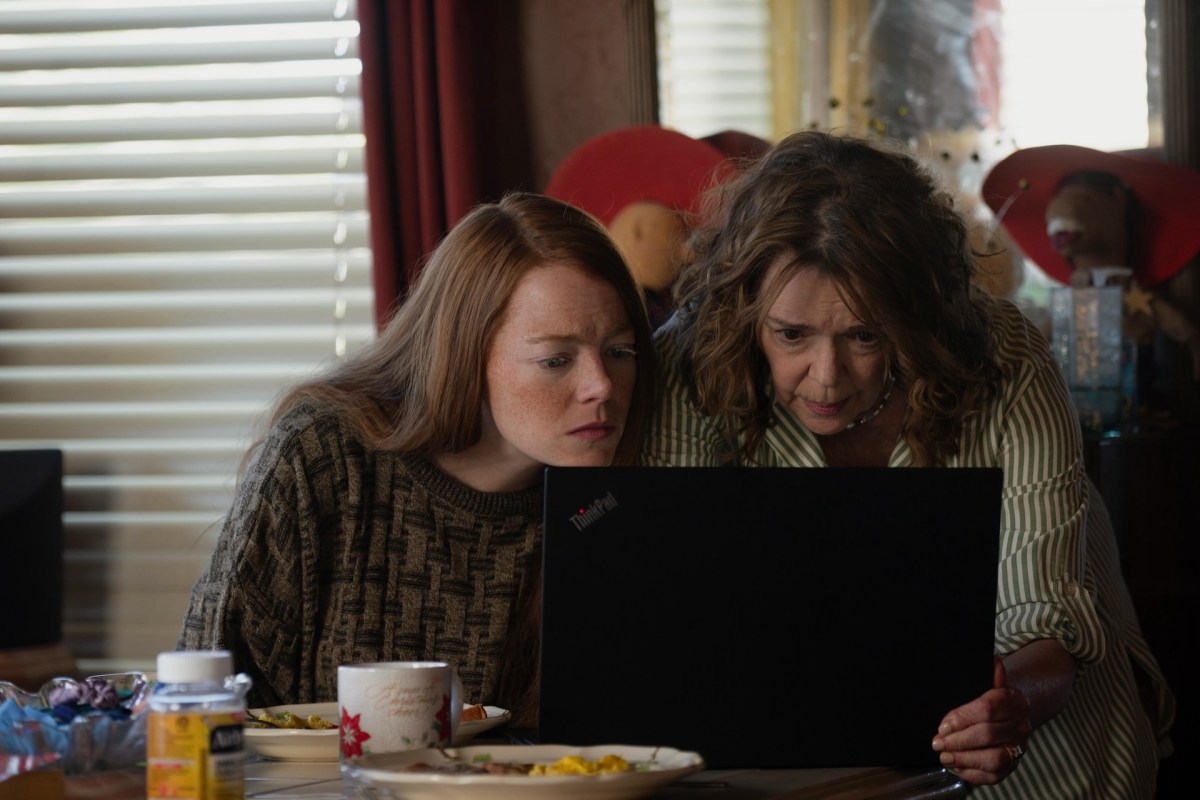
The film depicts how townsfolk spiral into factional madness while social media timelines dictate their sense of reality.
And then there’s a looming new data centre, run by a company with a curious name: SolidGoldMagikarp. The moniker is not just a random detail – it’s a direct reference to an obscure phenomenon from the world of artificial intelligence.
What is SolidGoldMagikarp?
The name originates in the research of Jessica Rumbelow and Matthew Watkins, who identified so-called ‘glitch tokens’ while studying large language models (LLMs). These tokens are bugs, or more accurately anomalies, in training data that can cause unpredictable behaviour in AI systems.
In 2023, the pair documented their findings in a LessWrong article, noting that when LLMs encountered tokens like ‘SolidGoldMagikarp,’ the outputs veered into nonsense, aggression or eerie speech.
Where do these tokens come from? The answer lies in how language models are trained. To process human language, AI systems break text into fragments called tokens. These tokens – sometimes words, sometimes just morphemes – are the units the model uses to calculate probability and generate its next output.
Most tokens behave predictably. But anomalous ones, such as SolidGoldMagikarp, sit in weird positions in the model’s ’embedding space,’ where their relationships to other tokens become unstable. Imagine I trained an AI model on a list of previous Oscar winners, but every second entry contained the phrase ‘GrapefruitBananaTaxi’. The model can’t distinguish between that and the relevant data, so the result is that the output makes little sense.
Speaking to Gizmodo, Rumbelow explained: ‘The system typically works really well, except when you have tokens that the model has never seen before … it doesn’t know what to do with the input.’ In other words: your Pokémon is confused!
Ok … but what exactly is a ‘SolidGoldMagikarp’?

SolidGoldMagikarp comes from the username of a Reddit contributor to r/Counting, a forum dedicated to logging sequential numbers (some folks collect stamps!). That forum was used as part of the Rumbelow and Watkins AI training dataset, and within it, the username ‘SolidGoldMagikarp’ appeared alongside many posts, so it skewed the model’s statistical understanding.
When prompted, the AI would then trigger bizarre tangents or hallucinations, such as lengthy riffs on the concept of ‘distribution.’
If you’re a Pokémon fan, you’ll also recognise Magikarp as the rather useless goldfish Pokémon that likes to splash around on the battlefield until its opponent KO’s it. I don’t know if Ari Aster is a Pokemon fan, but I can certainly draw parallels between Joaquin Phoenix’s mayor character in Eddington and Magikarp.
Let’s go further: cast your mind back to the GameBoy era, and you may remember an interaction from the original Pokémon Red and Blue games where a shady salesman tries to sell you a Magikarp for 500 Poké Dollars (and not even a gold one!). Using his sharpened charlatan’s tongue, he convinces unsuspecting trainers into thinking the fish is very valuable – but in reality, he’s scamming you. Perhaps Austin Butler’s charming cult leader Vernon would see himself in this guy.
ScreenHub: Eddington review: this town’s gonna blow
A golden glitch made real in Eddington
By naming and documenting the bug, Rumbelow and Watkins effectively turned SolidGoldMagikarp into something real. Online forums, papers and now Aster’s film have ensured the phrase carries meaning, where previously it was just a quirk of training data (and before that, a random username).
That odd threshold between unreality and reality, and the way that belief tips people over it, echoes throughout Eddington. The people of the town spiral because they accept distorted realities as truth. Pandemic conspiracies, partisan rage and culture war slogans feed their actions, regardless of evidence. Just as glitch tokens confuse AI into spitting nonsense, the townsfolk become destabilised by the constant churn of misinformation.
Why Aster chose Magikarp
Aster’s films traditionally end with darkness triumphant. Hereditary closes with a demonic coronation, Midsommar with ritual sacrifice, Beau Is Afraid with surreal humiliation. In Eddington, the victor is less supernatural: the internet itself.
As AV Club noted, the final images show the town erased, replaced by the humming SolidGoldMagikarp data centre, calmly devouring resources and reshaping the community in its image.
By naming the tech giant after an AI glitch token, Aster seems to suggest that we too are caught in systems that destabilise us. The randomness of an algorithm, the toxic pull of a newsfeed, the cascading effects of mistrust, can all be seen as glitch tokens, warping human behaviour in ways we barely yet comprehend.
The reference also lands at a moment when generative AI has entered the mainstream. Systems like ChatGPT operate on vast datasets, riddled with anomalies, biases and gaps. As researchers have shown, small aberrations can push these models into strange or dangerous territory. For the entertainment industry, this resonates strongly: the same tools that can produce screenplays, marketing copy or digital performances also carry risks of error, misrepresentation and instability. Is AI really all that valuable, or are we being sold a dud?
Aster’s choice is a warning about the brittleness of the systems ruling our digital lives. The town of Eddington is undone by believing in realities constructed by algorithms – will our society be the same? And when it comes time to face up to it, will our leaders be able to do more than Splash?
Eddington is in cinemas now.