Run and The Postcard Bandit: quick links
Run: true crime drama tells the story of The Postcard Bandit
You’re usually on a sure thing when it comes to true crime drama on Australian television. One of the best series ever made here – that’d be Blue Murder – was based on actual events; everything from The Great Bookie Robbery and Killing Time to the early series of Underbelly (not to mention films like Chopper) have proven that Australia often punches well above its weight when the subject is torn from the headlines.
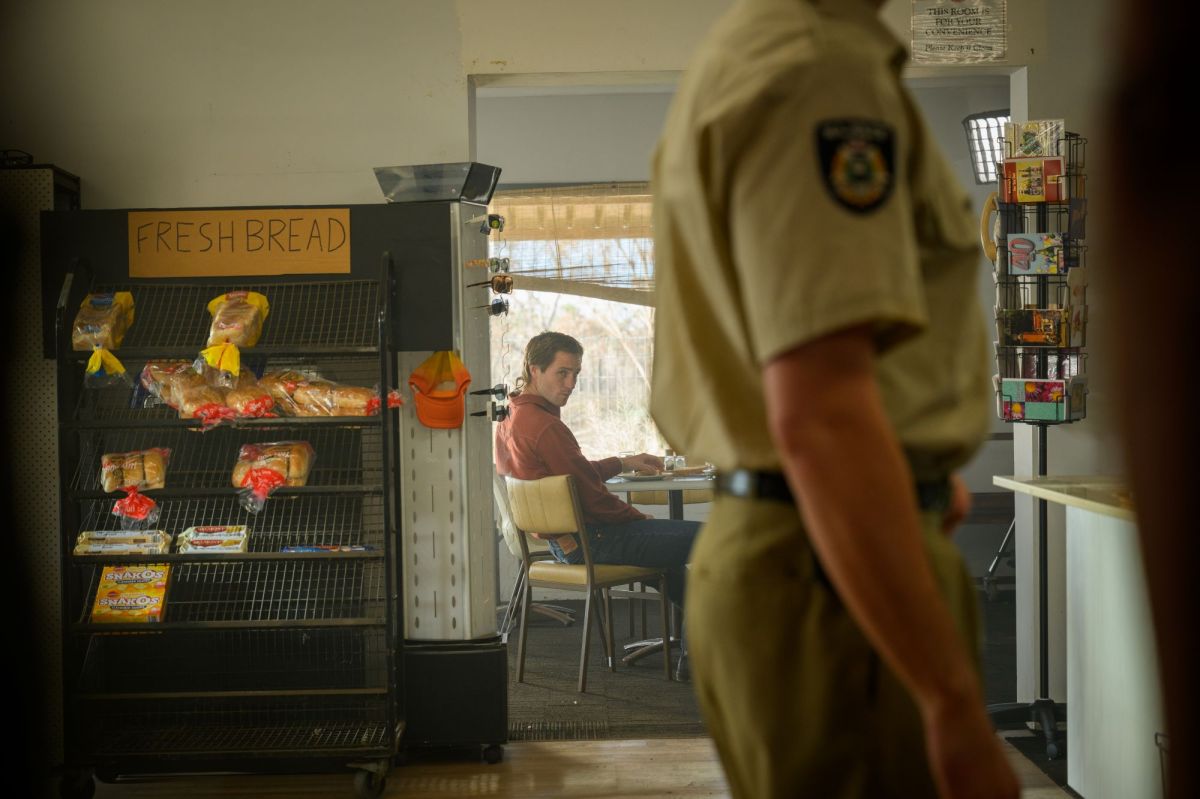
But shifting tastes in television have seen true crime dramas largely sidelined on our screens, giving new six-part series Run retro appeal beyond its 80s and 90s setting. For close to a decade, Brenden James Abbott (George Mason) was on the run, a professional armed robber committing high profile escapes from serious prisons then (supposedly) sending taunting postcards sent to police as they struggled to track him down. (Turns out the WA police made up the whole “postcard bandit” thing; the cards were images from a roll of film found when he was caught.)
A media obsession and pop culture figure before being finally and (to date) permanently caught, this isn’t the first time his story’s been told on the small screen – a Nine telemovie in 2003 starring the late Tom Long explored Abbott’s life and crimes. That’s no surprise: the adventures of highly intelligent crim who carefully planned his robberies and escapes and who spent years on the run from a nationwide manhunt should be edge-of-the-seat viewing.
Watch the trailer for Run
The Postcard Bandit: highlights the flaws in Run
Ironically, it’s the companion documentary series The Postcard Bandit that highlights the flaws in Run. Both a look back at his criminal history and the story of Abbott’s son James as he fights to have his father released, it seems at first like an easy way to get some extra use out of the crime scenes re-enacted for Run. But the extensive interviews with various (now retired) police officers involved in Abbott’s criminal history, alongside James’ struggles just to get to speak to his father, soon paint a more interesting picture.
Whatever you may think of Abbott’s crimes – and the documentary makes it clear that he was a violent criminal whose actions did lasting harm to those in his way – his decades behind bars do start to seem a touch excessive considering the only other Australians in prison longer than him are murderers. As documentaries go, this one is firmly on James’ side; those who think Abbott is getting what he deserves behind bars will no doubt be pleased by the (predictable) verdict of the courts revealed in part two.

It’s also hard not to come away from The Postcard Bandit with the feeling that just about everyone on the law and order side of things wants to punish Abbott primarily for the crime of making them look bad. Individually the police officers on camera are never less than professional, and yet you’d be forgiven for thinking that they took this particular case somewhat personally – and that they’re not exactly unhappy that they managed to have the last laugh.
Interspersed with the current-day developments is a potted history of Abbott’s crimes, which quickly and vividly outlines a criminal career full of memorable twists. With James covering the personal side of the story in the present day, the past is mostly focused on the police’s recollections and records of his criminal exploits. It’s an effective and gripping documentary that (deliberately?) leaves the question of who Abbott was in his heyday is left to the drama series; there, sad to say, the ball is fumbled.
Watch the trailer for The Postcard Bandit
Run: drama lacks edge
Opening with a range of jarring tonal shifts – a quiet prison visit then a brawl to start a riot then a jump back in time to one of Abbott’s more infamous robberies (in which he and a fellow robber hid in the celling of a Perth bank before dropping down just before opening) – Run then slams on the brakes so we can get up to speed on his various relationships. There’s brother Glenn (David Howell) who idolises him; mother Thelma (Robyn Malcolm), who’s almost your typical crime matriarch only she’s not in favour of actual crime; and girlfriend Jackie (Ashleigh Cummings), who may not be fully on board with life on the run.
In the midst of it all, Abbott comes off as something of a blank slate. Seeing the real thing on video chat in The Postcard Bandit, he immediately comes across as a very intelligent person, quick with a joke but always studying things, someone who’s always playing his own game. A bit more of that would have given Run more of an edge; instead we’re shown a version of Abbott that’s more impulsive, his planning and preparation skills mostly glossed over.
Even when Abbott’s in Freemantle prison, the series skips over details the documentary doesn’t miss. A big element in his first escape was that he used the resources of the sewing room he was working in to fashion multiple sets of blue overalls to conceal the escapees’ prison clothing, complete with fake uniform badges to make them seem like a work crew from a distance.
As shown in The Postcard Bandit, it adds to the picture of a cunning and resourceful criminal who thinks of all the angles; in Run, the overalls are just pulled out of a hiding place during the escape with no explanation at all.
Things pick up in the second episode, as the story shifts to the escapees keeping out of prison. Abbott gets more of an opportunity to show off his nous when it comes to crime, especially when compared to more volatile escapee Reynolds (Oscar Redding). But even when it seems like the series has found its theme – Abbott is finally on the run – there’s always something to trip it up.
The ongoing subplots about the police efforts to track Abbott down, which were fumbled for a number of years due to a lack of co-operation between various jurisdictions, never fire up in any consistent way. WA Detective Gary Porter (Keiynan Lonsdale) seems poised to be our second lead, but his subplot is poorly served. Seeing a teller Abbott terrorised early on (Julia Nihill) gradually fall apart from stress should add more to the picture than it does.
Run never quite comes into focus as either a close-up look at what drives a professional criminal or a big picture take on a nation-wide manhunt that took years to get into gear. There’s promising performances and interesting scenes scattered throughout (plus a moment set in 1987 where someone takes a selfie using a manual focus film camera), but overall The Postcard Bandit is the version worth checking out. In the end, Run never quite finds its feet.
Run: 3 stars
The Postcard Bandit: 4 stars
All six episodes of Run are now streaming on Binge and are available on Foxtel. The Postcard Bandit is available on Binge and Foxtel from 7 January.
Discover more screen, games & arts news and reviews on ScreenHub and ArtsHub. Sign up for our free ArtsHub and ScreenHub newsletters.
Actors:
Director:
Format:
Country:
Release: