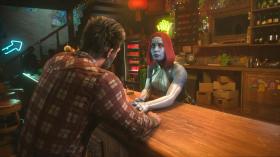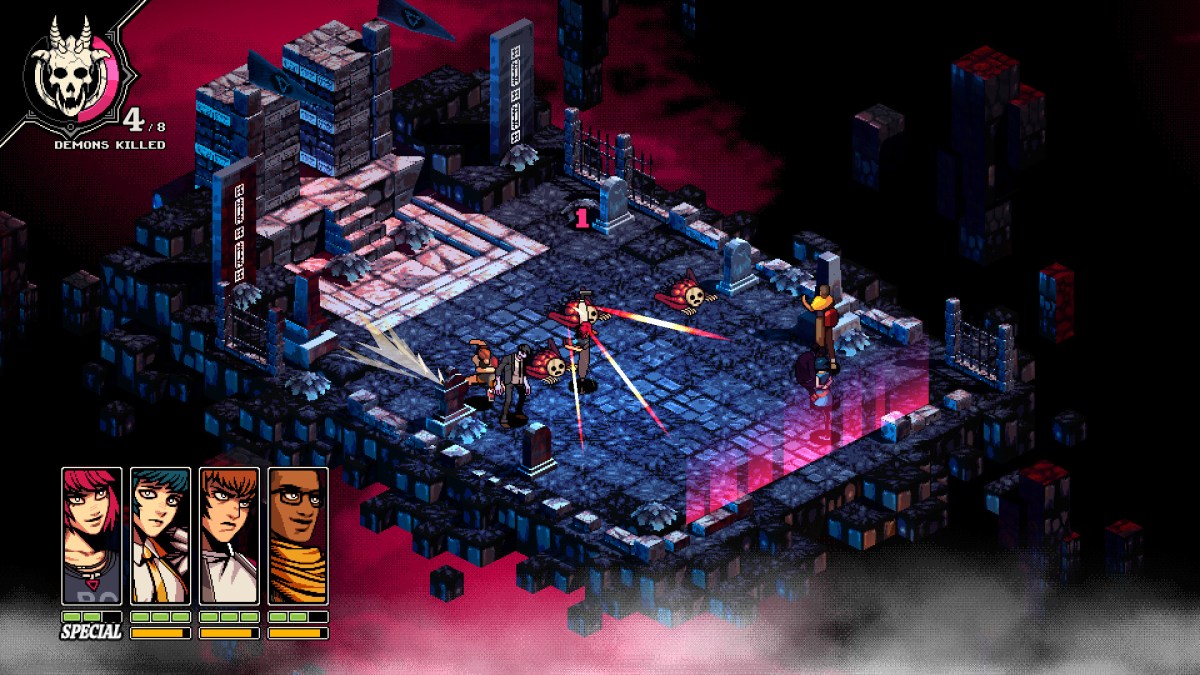
If your social media feeds are anything like mine, you’ve seen a lot of Demonschool over the last year or so. It’s a game that translates extremely well to gifs, thanks to its wonderful art and focused aesthetic, and that sense of style translates over to the full game too. When battles commence, the diorama world you’ve been exploring peels away as the battlefield drops into place. In cutscenes, the view may dip and zoom to a different perspective. It looks cool every time, and the world design is awesome.
It’s a beautiful game with obvious love poured into it, featuring a unique battle system and some pleasant Persona-lite ‘life sim’ elements, where you explore the town you’re in and build your friendships between battles. The soundtrack is appropriately ear-wormy, and the character art all looks great. The game really does have a lot going for it.
There’s a ‘but’ coming here, and it stings a bit, because Demonschool is the kind of game you really want to be able to say is amazing. But as it stands, Demonschool is, for all its style and flair, just okay as a game. As lovely as it is in many ways, it’s also just a little dull.
Demonschool review – quick links
Heading off to Demonschool
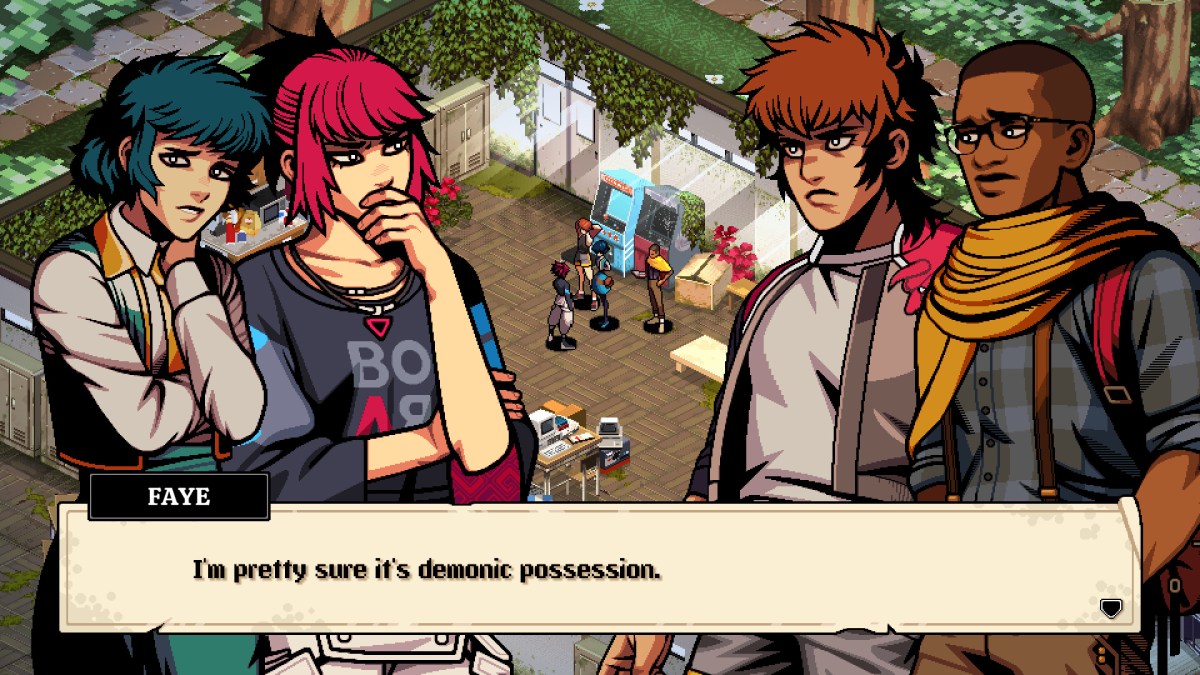
At the start of Demonschool you’re introduced to Faye and Namako, two girls who are on board a ferry on their way to a new school – one Faye knows is being overrun with demons. There is a lot of storytelling in Demonschool, yet it all feels very thin. At the beginning, there’s little sense of why you’re on this island, or even what the deal with this school is. The dialogue is jokey in a way that undercuts the game more than it entertains, and although I did find myself gradually growing more attached to some characters as the game unfolded I never felt particularly invested in the game’s storytelling.
Read: Hollow Knight: Silksong causes ripple effect of game delays
There are, you’re told at the start of the game, 10 weeks until the apocalypse arrives, although there’s no real sense of urgency or danger attached to that proclamation. You control Faye as she attends school and slowly forms a demon-hunting club (the members of your party) and every week your teacher gives you a new mysterious task to complete.
These tasks always boil down to travelling between locations on the map and experiencing the story beats. There are no real puzzles outside of some very simple mini-games, and side quests never amount to much either.
Demonschool’s combat system
The entire driving force of the game is its combat system. When you encounter demons and are sent to battle, the screen transforms into a fixed tableau of a grid system, which you place your characters on. To win a battle, you need to defeat a fixed number of demons and get at least one character to the other end of the battlefield to ‘seal’ the evil forces back in their demonic realm.
To fight, you simply need to move your characters into the squares of your opponents, and characters can attack in the cardinal directions or diagonally. It’s a bit like chess, except that characters have hit points, special moves, and unique strengths and weaknesses.
During a turn, you have eight movement points to spend – the first time you move a character it costs one point, two points the second time and so on – so you’ve incentivised to use everyone instead of relying on one heavy hitter. You can line your characters up to perform joint combos, unleash special moves and use objects in the environment to your advantage.
It’s a cool system, but one that never quite feels like it’s being properly tested by the actual battles and scenarios the game throws at you. The rollout of new abilities, enemies and teammates – anything that could change the way you do battle – is very slow and all the battles tend to feel very similar to one another.
The deeper into the game I got, the more my brain switched off when I was sent, yet again, to face off against a grid full of ghouls, which is an issue when that’s really the main thing the game is offering.
Watch the Demonschool trailer
Risks and rewards
Each battle, you’re given a target for how many turns you should try to end it in, and if you can do that while keeping your whole team alive, you’ll earn the maximum reward. While I found myself not caring too deeply about the resource management side of the game (it’s not particularly difficult) there was some intermittent satisfaction trying to adjust my strategy and plan out each move in the hope of hitting the target.
Boss fights, at least, are a bit more inventive and exciting. The bosses that you face off against (usually towards the end of each in-game week) all look fantastic and require a more strategic approach than regular battles. Carefully plotting your moves to get close and land your killing blows feels good and it’s a shame more of the game’s battles didn’t require a similarly strategic approach.
Demonschool is a game I appreciated more than I enjoyed. It’s a collection of great ideas, brilliant artistic choices and fun moments but they don’t quite stitch together into a game as good as the one you imagine from the screenshots and GIFs. There’s definitely something here; when I’m not actually playing Demonschool, I think of it more fondly than I do when the controller’s in my hand. It’s still worth playing if you have a soft spot for cool indie games with impeccable style, and can forgive them when they don’t quite hit the mark.
Demonschool is launched 20 November.
Discover more screen, games & arts news and reviews on ScreenHub and ArtsHub. Sign up for our free ArtsHub and ScreenHub newsletters.
Developer
Necrosoft Games
Publisher:
Ysbryd Games
Release Date:
20 November 2025