Something is happening to movies. Slowly but surely, their colours are leaking out. Films and even series for TV and streaming are now seemingly developed with a darker or desaturated colour palette in mind – all deep blacks, brown and beige, and distinctly low contrast.
This isn’t a new phenomenon in 2026. ‘Why are movies so dark now?’ has become such a common question and complaint online that there’s been ample thought leadership developed over the last few years. The internet is riddled with theories, and there are some compelling ones.
Perhaps filmmakers are looking to create more realistic scenes by focusing on natural light within a cinematic scene. Films pre-2000s were largely hyper-lit, with unrealistic light sources allowing for brighter, bolder but arguably less ‘real’ scenes.
Other commentators have suggested modern filmmakers are playing to the capability of modern screens, with OLED technology being relied on to differentiate grades of light and dark while maintaining a realistic approach.
If the years of discourse around this filmic darkness is anything to go by, audiences are fed up. Even those with higher-capability OLED screens have complained for years about a standardised lack of contrast, and difficult-to-see scenes.
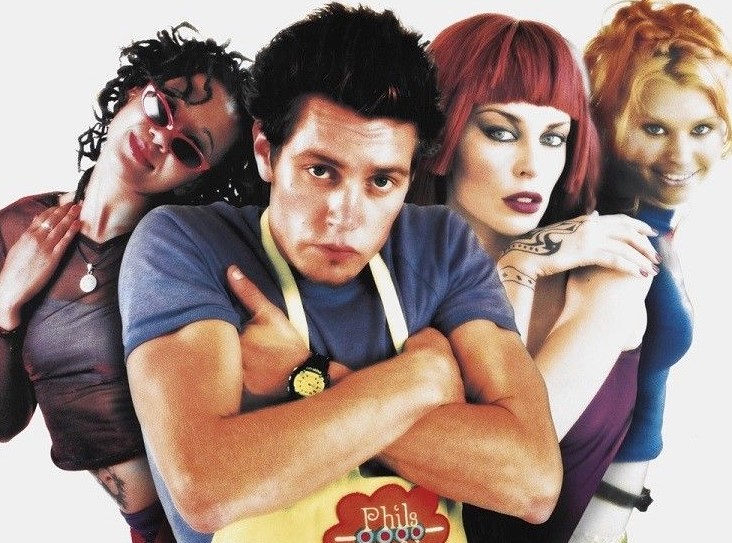
It’s why the recent return of cult Australian-made film Sample People (2000) in a screening at the Sydney Opera House was so refreshing. A vibrant and creative experience, its use of colour is spectacular.
Sample People and colour in film – quick links
The pop aesthetic of Sample People
Sample People wields colour as a multi-faceted tool, using it to underscore the journey of several troubled Sydneysiders as they make their way to a kebab shop where everything goes wrong.
It’s striking from the offset, with the saturated colour delivered via sets, strong diffused lighting, and each character’s wardrobe palette.
Kebab shop employee Len and his boss both wear a soft lilac purple and lime green – a combination typical of the late 1990s in which the film is set, and now back in fashion as of the 2020s. There’s a lightness and fun to these costumes, although the colours here eventually come to mark the oppression of Len’s self-expression.
ScreenHub: Sample People returns after 26 years: ‘We had so many great actors’
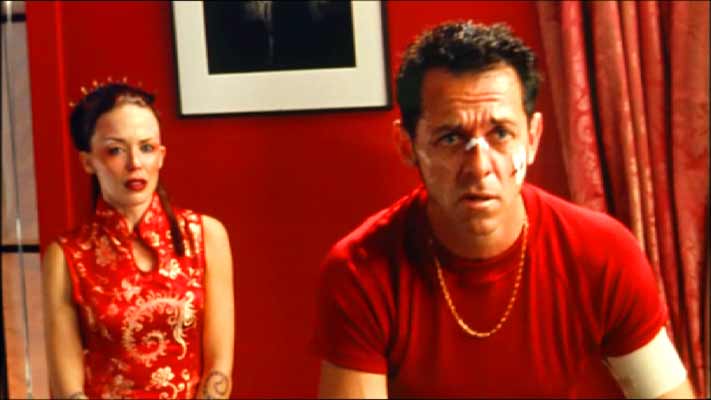
Kylie Minogue, as the femme fatale Jess, typically wears bold shades of red, a colour carried into her wigs, lipstick and Chinese-influenced attire. She’s all harsh, bold colours, with that red doing a lot of the legwork to mark her out as deadly and dangerous. A firecracker in disguise.
Fashion on the whole is used well here to define character, even beyond colour.
Red is also a feature in the outfit of John, played by Ben Mendelsohn, a gothic young man who wears his makeup like a uniform – a signal to everyone that he’s different and therefore special.
When Len finally strikes out on his own, his transformation is represented visually in a shiny galaxy outfit designed to be the colourful, bold and cool representation of change and self-assuredness.
Beyond fashion, the colourful lighting of Sample People goes plenty of the way towards defining the rest of its drama.
Blues and reds collide in a battle of emotion
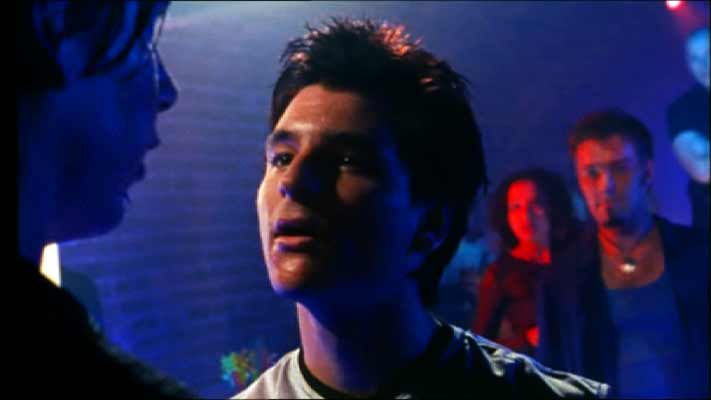
The lighting – so often the difference between approachable scenes and complete muddiness – is a standout here. In shades of blue, red and sepia, the intention of Sample People is delivered so well.
You see Len’s anxieties in shades of deep blue. You see the danger inherent in Jess’ path in a red that reflects the tones of her wig. In parts, Sample People is perhaps too obvious in how it wields colour – but in the absence of any bold colour at all in the modern era, it’s a remarkable feature of this unique film.
Watching Sample People for the first time in 2026 was a revelation. Not only for how fashion is cyclical and many of the looks in the film wouldn’t be out of place in the Sydney of today. But also to see how film has changed over the last three decades, particularly in the use of colour.
This film was created with a rich visual palette in mind, with colour serving as elevation of character and aesthetic. That’s really the crux of Sample People – it’s about the repetition of style and how colour and fashion becomes us.
Against the backdrop of modern films, where the power of colour and good lighting has seemingly been set aside, it it’s an important artefact of Australian film history and the artful techniques that have defined it.