Sony has patented the use of an ‘AI Generated Ghost Player’ for video games, which would aid players stuck on particularly difficult or obtuse segments of games. The patent was first filed with the World Intellectual Property Organisation in September 2024, with a recent status report catching the attention of VGC.
In light of the rising tension around AI’s place in video game development, the patent has received renewed attention – and some level of criticism.
Sony’s AI-generated ghost player – quick links
What is Sony’s AI-generated ghost player patent about?
As detailed in Sony’s patent filing, its ‘Ghost Player’ system is planned as a tool to help players through video games, with AI providing hints to solve challenges and even performing gameplay sequences.
In the filing, a diagram depicts this as a step-by-step process. Players will have the option to deploy a ghost character that uses an AI model to process the game state and then provide input.
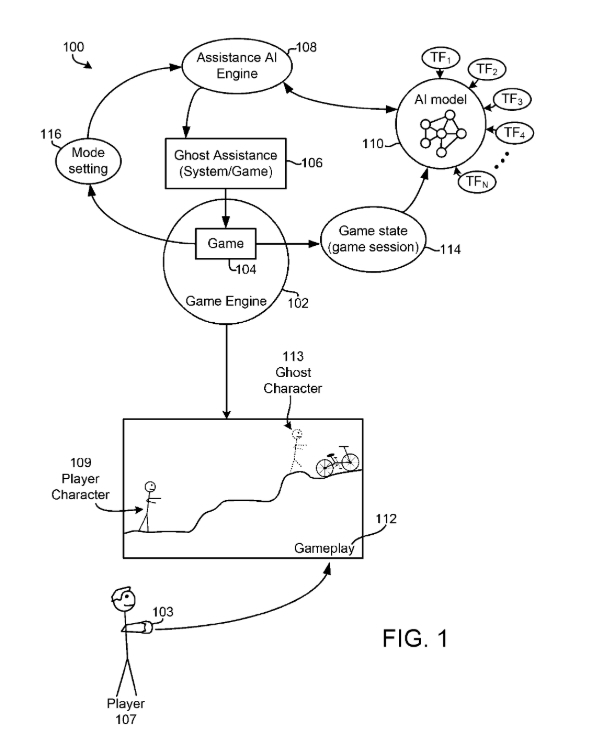
As detailed in the abstract: ‘The method includes rendering, during the game session, the ghost character performing interactive actions in the game. The interactive actions are generated responsive to control inputs generated by the assistance AT engine. The interactive actions by the ghost character are configured to progress the ghost character along an interactive path of the game.’
Sony details the need for the technology in its background description: ‘Although video game technology has seen many advances, some players find themselves in need of assistance. Games become very complicated, so players who are not experts oftentimes quit playing or find it hard to complete tasks.’
‘Players are able to do research for the game or even lookup prior gameplays on internet sites, but that process is time consuming and many times not very relevant to tasks and/or scenarios currently being encountered by the player.’
Essentially, Sony sees a challenge in players getting stuck in complex video games, and has determined that the process of searching for solutions (often a simple Google search) is too time consuming, or produces information that is irrelevant to player needs.
The patent suggests the solution lies in using AI to directly provide input into the game, creating a ghost for players that actively plays the game on their behalf.
This ghost would be trained using actual footage of gameplay to identify the core problems facing players, and it would then perform the necessary steps to progress the game.
Are ghost players really necessary?
Since Sony’s ghost player patent was highlighted, there’s been much debate about its practical usefulness in the world of video games.
The reality is, it’s not the only system facing this discourse – as Microsoft has also faced plenty of debate following the release of its Copilot for Gaming system, which provides AI-driven hints and tips for players based on gathered knowledge.
There’s no argument that games have become more complex in the modern era. But that complexity is often what makes games more engaging and dynamic. Should developers not be trusted to create puzzles that satisfy a game’s audience base, testing their skills with just the right amount of hints? An AI ghost laid over the top of games would seemingly dilute the vision of developers.
Not everything should be easy. Learning is part of the fun of video games: puzzling through solutions, engaging critical thinking skills, and developing better reaction times to advance.
At this stage, it’s unclear whether Sony is planning to implement this AI-driven system into its future games. Given the patent is relatively new, it could be early days, with new developments to come.
For now, it’s best to keep an eye on progress, to see whether the future of gaming will involve more AI-generated features such as this.